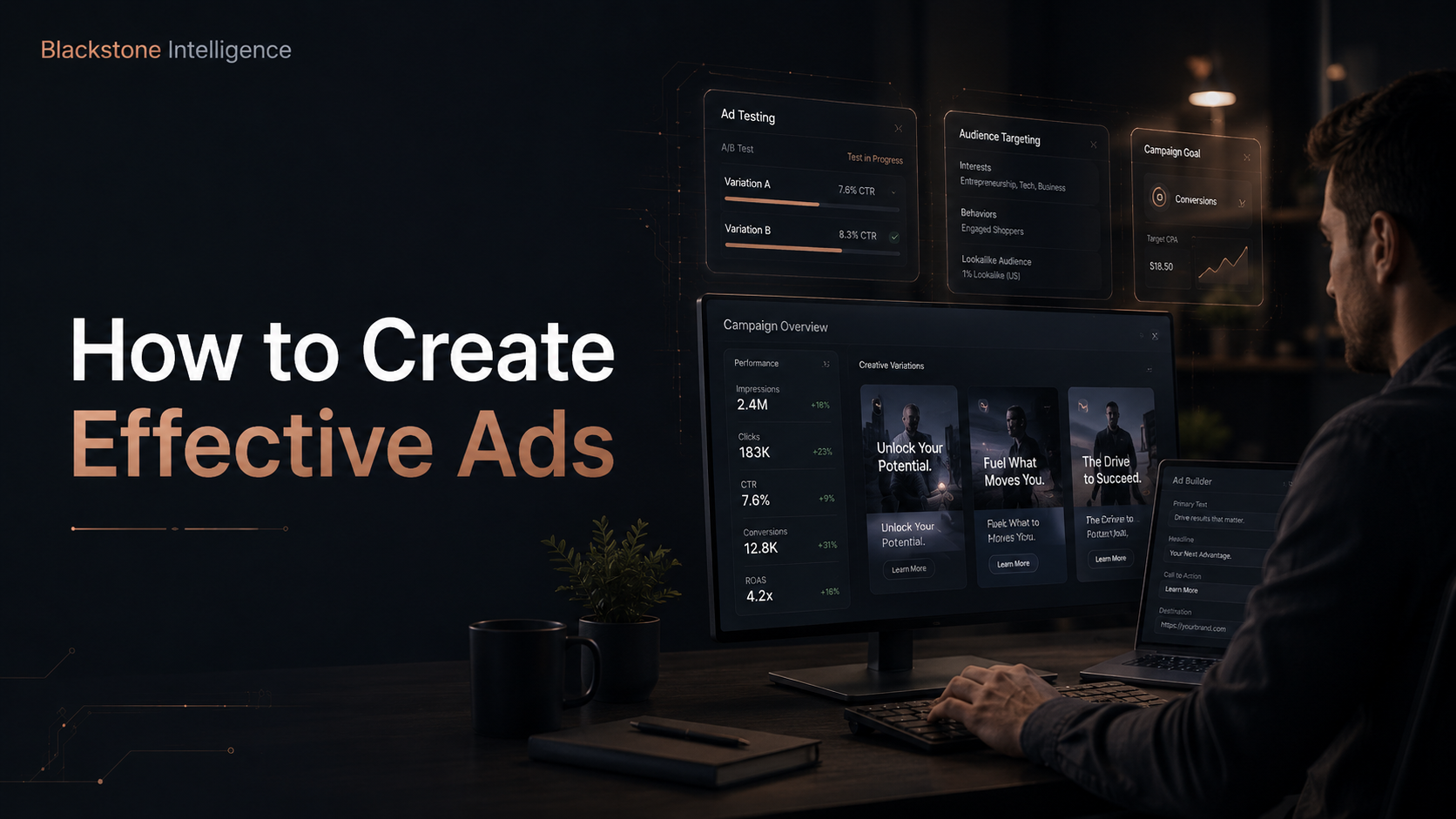
Advertising in 2026 is no longer judged by whether it looks polished or generates attention for a few seconds. For Malaysian businesses, the more important question is whether an ad can move the right audience from awareness to action in a market where media costs, consumer expectations, and platform algorithms continue to change.
This is why the question of **How to create effective ads** needs to be approached as a business problem, not just a creative task. A strong ad must connect three things clearly: the commercial objective, the customer's motivation, and the channel context in which the message appears. When any one of these is weak, performance usually suffers. A visually attractive ad may still fail if the offer is unclear. A clever message may be ignored if it does not address a real customer concern. A strong promotion may underperform if it is shown to the wrong audience at the wrong stage of decision-making.
For Malaysian business owners and marketing teams, the challenge is especially practical. Many companies operate across mixed customer segments, multiple languages, different income groups, and varied buying behaviours across urban and regional markets. An ad that works for a premium audience in Kuala Lumpur may not work for a price-sensitive audience in another state. Likewise, what performs on TikTok may not translate directly to Google Search, LinkedIn, Meta, or marketplace advertising.
Blackstone Consultancy would analyse ad effectiveness from a strategic growth perspective by looking beyond surface metrics such as likes, reach, or impressions. These numbers may indicate visibility, but they do not always show commercial progress. A more useful analysis considers the full role of the ad: whether it attracts qualified attention, communicates value quickly, reduces uncertainty, supports the sales journey, and creates a measurable next step.
The starting point is clarity. Every effective ad should answer a simple question: why should this customer care now? From there, the creative direction, headline, visual, offer, audience targeting, and call-to-action must work together. The best ads are not necessarily the loudest or most complex. They are often the ones that make the value obvious, remove friction, and guide the customer toward a decision.
In 2026, effective advertising will favour businesses that combine creative discipline with strategic measurement. The winning approach is not to produce more ads randomly, but to build a repeatable system for testing messages, understanding customers, and improving what drives real commercial outcomes.
What The Market Is Really Responding To
Effective advertising is not just about getting attention. Malaysian customers are exposed to constant promotions, price comparisons, influencer content, marketplace campaigns, and brand messages across multiple platforms. What they respond to is not always the loudest ad, but the clearest signal that a business understands their need, timing, risk, and buying motivation.
For business owners asking **How to create effective ads**, the starting point is not the creative format. It is understanding what the market is already showing through behaviour.
Customer Behaviour: Attention Is Selective
Customers do not give every ad equal consideration. They quickly filter messages based on relevance, familiarity, urgency, and trust. A user scrolling through social media may ignore a polished brand video but stop for a simple message that reflects a problem they are currently facing.
This means ads must match the customer's stage of awareness. A first-time buyer may need education and reassurance. A returning customer may respond better to a direct offer, bundle, limited-time reminder, or product comparison. The same creative will not work equally well for every audience.
Malaysian audiences are also highly platform-sensitive. What works on TikTok may feel too casual on LinkedIn. What performs on Instagram may need a clearer offer when adapted for Facebook or Google Display. The market responds when the message fits the environment.
Category Signals: What Buyers Expect Before They Click
Every industry has signals that shape buyer confidence. In beauty, customers may look for visible outcomes, ingredients, reviews, and usage guidance. In property, they expect location, pricing context, financing information, and credibility. In B2B services, they want proof of expertise, process clarity, and commercial relevance.
Good ads recognise these category expectations. They do not force customers to guess. If the product is premium, the ad should communicate why. If the service solves a business problem, the ad should make the problem and outcome easy to understand.
A social media agency can help structure these signals into campaigns, but the business must first be clear on what customers need to believe before they enquire or purchase.
Brand Perception And Commercial Intent
Ads do more than generate clicks. They shape how people judge the brand. An aggressive discount message may bring short-term traffic but weaken perceived value if used too often. A vague "premium" message may look attractive but fail to convert if it does not explain the benefit.
Commercial intent is strongest when the ad connects three things: a relevant problem, a believable solution, and a clear next step. The market responds when the customer can quickly answer, "Is this for me, why should I trust it, and what should I do now?"
The Strategic Pattern Beneath The Surface
Effective advertising is rarely the result of one clever headline or a polished visual. Beneath every strong campaign is a pattern that connects five commercial questions: what the market already believes, what the business wants to be known for, what offer is easy to act on, what people are actively searching for, and what finally convinces them to enquire or buy.
For Malaysian businesses, this matters because audiences are exposed to offers across marketplaces, social feeds, search results, WhatsApp conversations, and physical retail environments. The ad is only one visible point in a larger decision journey.
Positioning Comes Before Promotion
Before asking **How to create effective ads**, a business should clarify the position it wants to occupy. Are you the safer choice, the faster provider, the specialist, the affordable alternative, or the premium option? Without this, advertising becomes a collection of disconnected messages.
A restaurant promoting "delicious food", a clinic promoting "quality treatment", or a B2B firm promoting "professional service" may be truthful, but these claims are too broad to guide buyer choice. Strong positioning narrows the message so the audience immediately understands why this brand should be considered over another.
The Offer Must Reduce Friction
An ad becomes more persuasive when the offer is simple to understand and easy to evaluate. This does not always mean a discount. It could be a consultation, a starter package, a clear bundle, a trial, a transparent price range, or a specific outcome the customer can recognise.
The key is to remove uncertainty. If a customer has to guess what happens next, compare too many options, or ask basic questions before taking action, the offer is carrying too much friction.
Search Demand Reveals Commercial Intent
Search behaviour shows what people are already trying to solve. Social media may create attention, but search often reveals urgency. A useful advertising strategy studies both: what people are saying publicly and what they are actively looking for when they are closer to making a decision.
This helps avoid campaigns built only around what the business wants to promote. Instead, the message can be shaped around real demand, common objections, seasonal interest, location-based needs, and comparison behaviour.
Conversion Behaviour Completes The Pattern
The final test is not whether an ad looks good. It is whether the audience understands the value, trusts the next step, and feels enough urgency to act. Track the points where people hesitate: low enquiry quality, abandoned forms, unanswered WhatsApp chats, weak landing pages, or unclear follow-up.
The strongest campaigns are built backwards from these behaviours, not forward from creative preference.
Audience, Message, And Channel Fit
Effective advertising is not only about better wording or nicer visuals. It is about matching the right promise to the right audience at the right stage of decision-making. For Malaysian businesses, this matters because the same buyer may behave very differently across TikTok, Google Search, WhatsApp, LinkedIn, Shopee, or a physical retail environment.
A useful starting point is to stop treating "the audience" as one group. Segment by intent, not just demographics. A 28-year-old comparing home renovation contractors, a procurement manager shortlisting B2B vendors, and an existing customer considering an upgrade all require different proof before they act.
Segment By Buying Stage
Problem-aware audiences need clarity. They may know something is wrong, but not yet know the best solution. Ads for this group should lead with the pain point, consequence, or opportunity. Educational short videos, search-friendly content, and simple carousel ads often work well here because the buyer is still forming their opinion.
Comparison-stage buyers need confidence. They are evaluating price, quality, credibility, delivery time, warranty, compliance, or after-sales support. This is where testimonials, product demonstrations, transparent packages, case-based explanations, and comparison content can help. The message should reduce perceived risk, not merely repeat a promotional offer.
Existing customers need relevance. They already know the brand, so the ad should focus on cross-sell, repeat purchase, loyalty, renewal, or referral. Email, WhatsApp broadcasts, remarketing, and CRM-driven campaigns are often more suitable than broad awareness channels.
Internal stakeholders are often forgotten. In B2B campaigns especially, the person clicking the ad may not be the final decision-maker. Your ad journey should provide materials that help them justify the decision internally, such as brochures, proposal points, compliance notes, or ROI explanations.
Match The Channel To The Decision
Social platforms are strong for discovery, but they should not be forced to close every sale immediately. Search works best when demand already exists. LinkedIn can support higher-consideration B2B offers, while marketplaces are suited to price-sensitive and product-led decisions. WhatsApp remains important in Malaysia because many buyers want quick clarification before committing.
The practical lesson in **How to create effective ads** is this: do not judge every channel by the same metric. Awareness channels should be measured by qualified engagement and audience growth. Consideration channels should be measured by enquiries, saves, repeat visits, and content depth. Conversion channels should be judged by sales, booked calls, cost per lead, and lead quality. When audience, message, and channel fit properly, advertising becomes easier to diagnose and improve.
What Malaysian Businesses Can Apply
For Malaysian businesses, the lesson is clear: effective advertising is no longer just about increasing media spend. It is about making every impression work harder through sharper creative, faster messaging, and better alignment between platform, audience, and offer.
Build Ads Around the First Few Seconds
Whether your audience is scrolling TikTok, Instagram Reels, Facebook, YouTube Shorts, or LinkedIn, the opening moment decides whether they continue watching. Malaysian brands should avoid slow introductions, long brand stories, or generic product shots at the start.
Lead with the problem, outcome, offer, or tension. For example, instead of opening with "We are a trusted provider of accounting services," a stronger opening might address a direct pain point: "Still closing your monthly accounts at the last minute?" This gives the viewer a reason to pay attention immediately.
Localise the Message, Not Just the Language
Many ads fail because they feel copied from a global template. Malaysian audiences respond better when the creative reflects local buying behaviour, cultural context, and platform habits. This may include using Bahasa Malaysia, English, Mandarin, or Tamil depending on the audience segment, but localisation goes beyond translation.
Consider the customer's daily environment: Klang Valley commuters, SMEs managing cash flow, parents comparing education options, or homeowners evaluating renovation costs. A social media agency should help convert these real situations into creative angles that feel relevant rather than forced.
Keep One Ad to One Job
A common mistake is trying to make one ad explain the company, promote the product, build trust, announce a discount, and ask for an enquiry. This creates confusion. Each ad should have one core objective.
If the goal is lead generation, focus on the pain point and the next step. If the goal is awareness, focus on recall and relevance. If the goal is retargeting, address hesitation with proof, comparison, or a stronger offer. Clear creative direction makes campaign optimisation easier and helps your digital marketing team identify what is actually driving performance.
Treat Creative Testing as a Business Process
Businesses should not rely on one "perfect" ad. Prepare multiple hooks, formats, captions, and calls-to-action before launching. Test different angles such as price, convenience, expertise, speed, quality, or risk reduction.
The practical answer to **How to create effective ads** is to build a repeatable system: understand the audience, develop focused creative, test variations, read performance data, and improve continuously. This approach is especially important in Malaysia's competitive digital environment, where attention is limited and customers compare options quickly before making contact.
Measurement That Keeps The Strategy Honest
Effective advertising is not measured by whether the team likes the idea, or whether a competitor appears to be doing something similar. It is measured by whether the campaign attracts the right people, creates meaningful action, and supports commercial outcomes without putting pressure on operations or reputation.
For Malaysian businesses, this is especially important because audiences often compare options across Google Search, social platforms, WhatsApp, marketplaces, review sites, and physical outlets before making a decision. A strong measurement system keeps the team focused on evidence, not assumptions.
Start With Search Intent
Search behaviour is one of the clearest signals of demand quality. Before judging an ad by clicks alone, review what people are searching before and after seeing the campaign. Are branded searches increasing? Are users searching for pricing, location, reviews, product comparisons, or service availability?
This helps separate curiosity from buying intent. If an ad generates traffic but no meaningful follow-up searches, the message may be entertaining but commercially weak. When planning **How to create effective ads**, search data should be used to confirm whether the campaign is helping people move closer to a decision.
Measure Engagement Quality, Not Just Volume
High reach and low-cost clicks can be misleading. A practical review should include time on page, scroll depth, video completion, repeat visits, saved posts, comments with buying questions, and direct messages that show genuine interest.
The key question is simple: did the engagement create understanding, trust, or next-step intent? If people are clicking but quickly leaving, the creative may be attracting the wrong audience or overpromising in the hook.
Track Lead Quality And Sales Readiness
Not every lead has the same value. Teams should categorise enquiries by source, urgency, budget fit, location, decision timeline, and product or service match. This is especially useful for industries where the sales team handles WhatsApp enquiries, calls, walk-ins, or quotation requests.
If a campaign produces many leads but few qualified conversations, the problem may be targeting, offer clarity, pricing expectations, or weak pre-qualification. A smaller number of better-matched leads is often more useful than a large database of people who were never likely to buy.
Watch Operational Signals
Good advertising can still fail if operations cannot support the promise. Monitor response time, stock availability, appointment capacity, delivery reliability, customer complaints, refund requests, and review sentiment.
These signals reveal whether the campaign is creating demand the business can actually fulfil. If advertising increases enquiries but customers wait too long for replies, the campaign may damage trust instead of building it.
Build A Repeatable Review Loop
Set a fixed review rhythm: weekly for live campaign adjustments, monthly for channel performance, and quarterly for strategic learning. Keep the discussion disciplined: what attracted attention, what created qualified action, what caused friction, and what should be stopped, improved, or scaled.
This turns measurement into a business habit, not a post-campaign report.
Risks, Trade-Offs, And Better Questions
Effective advertising is not about copying what looks popular. A competitor's short video, bold offer, influencer partnership, or humorous campaign may be visible because it is well-funded, heavily repeated, or simply new. Visibility does not mean profitability. Before adopting any tactic, Malaysian business owners should ask whether it fits their audience, margin structure, sales cycle, and brand position.
Mistakes That Quietly Weaken Ad Performance
One common mistake is trying to say too much in one ad. When a business promotes every product feature, discount, award, and contact method at once, the audience receives no clear reason to act. Another mistake is judging ads too early. A campaign may need enough spend, impressions, and response data before conclusions are useful.
Teams also risk over-optimising for cheap clicks. Low-cost traffic can look attractive in reports, but if it does not produce qualified enquiries, store visits, repeat purchases, or sales conversations, the campaign is not commercially strong. The question is not only "did people click?" but "did the right people move closer to buying?"
Questions To Ask Before Copying A Tactic
Before following a visible trend, ask:
- Is this tactic suitable for our actual customer segment?
- Does it match the price point and decision-making process of our product?
- Can our team follow up quickly if leads increase?
- Will this offer damage perceived value or train customers to wait for discounts?
- Are we measuring business outcomes, or only platform metrics?
- What would make us stop, adjust, or scale this campaign?
These questions are especially important for SMEs with limited budgets. A tactic that works for a large brand with national reach may not work for a local services firm, property business, education provider, clinic, or B2B company with a longer buying cycle.
Stay Commercially Grounded
The best way to approach **How to create effective ads** is to connect creative decisions to commercial realities. A strong hook is useful only if it attracts the right audience. A sharp offer is valuable only if the business can fulfil it profitably. A high-converting landing page matters only if enquiries are handled properly.
Advertising should be reviewed with both marketing and sales input. Look at lead quality, customer objections, closing rates, average order value, fulfilment capacity, and repeat business potential. When teams combine creative discipline with financial discipline, ads become more than content; they become a managed growth tool.
A Practical Roadmap For Turning The Insight Into Action
Knowing **How to create effective ads** is only useful when the insight becomes a repeatable business discipline. For Malaysian companies planning their next marketing cycle, the objective should not be to produce more ads, but to build a system that consistently connects market behaviour, creative decisions, and commercial outcomes.
1. Start With The Business Decision
Before briefing any campaign, leadership should clarify what decision the advertising is meant to support. Is the priority to generate qualified enquiries, defend market share, introduce a new product, improve store visits, or support distributor activity?
This matters because different goals require different creative approaches. A campaign built for awareness should not be judged using the same expectations as a lead-generation campaign. Agreeing on the commercial purpose early helps prevent unclear messaging, weak offers, and conflicting feedback during approval.
2. Define The Audience In Operational Terms
Avoid broad descriptions such as "SMEs", "parents", or "young professionals". Instead, describe the audience by buying situation, urgency, objections, and decision process.
For example, a business owner comparing service providers has different concerns from a first-time buyer discovering a brand. One may need proof and reassurance; the other may need a simple reason to pay attention. This distinction should shape the hook, visual treatment, offer, and landing page.
3. Translate Insight Into A Creative Brief
A useful brief should include:
- The customer problem being addressed
- The main reason to believe the brand
- The single message the ad must deliver
- The action the audience should take
- The proof points that can be shown clearly
- The channels where the ad will appear
- The measurement criteria for success
The brief should be short enough for creative teams to use, but specific enough to stop the campaign from drifting into generic claims.
4. Build A Testing Calendar, Not One-Off Campaigns
Plan creative testing in stages. Start with several angles, identify which messages earn attention, then refine the strongest executions. Test hooks, visuals, offers, and calls-to-action separately where possible.
This allows the marketing team to learn why something works, rather than simply declaring an ad successful or unsuccessful. Over time, those learnings become a practical creative playbook for the business.
5. Review Performance With Sales And Operations
Marketing data should not be reviewed in isolation. A campaign may generate clicks but poor enquiries, or fewer leads that convert better. Include sales teams, customer service staff, and branch or outlet managers in the review process.
Their feedback can reveal whether the ad attracted the right audience, whether the offer was understood, and whether the customer journey after the click supported conversion.
6. Turn Every Campaign Into An Asset
At the end of each cycle, document what was learned. Keep records of winning messages, underperforming claims, audience objections, useful visuals, and channel-specific observations.
The strongest advertisers are not simply more creative. They are more systematic. They convert market insight into better briefs, sharper messages, cleaner measurement, and faster decision-making for the next campaign.