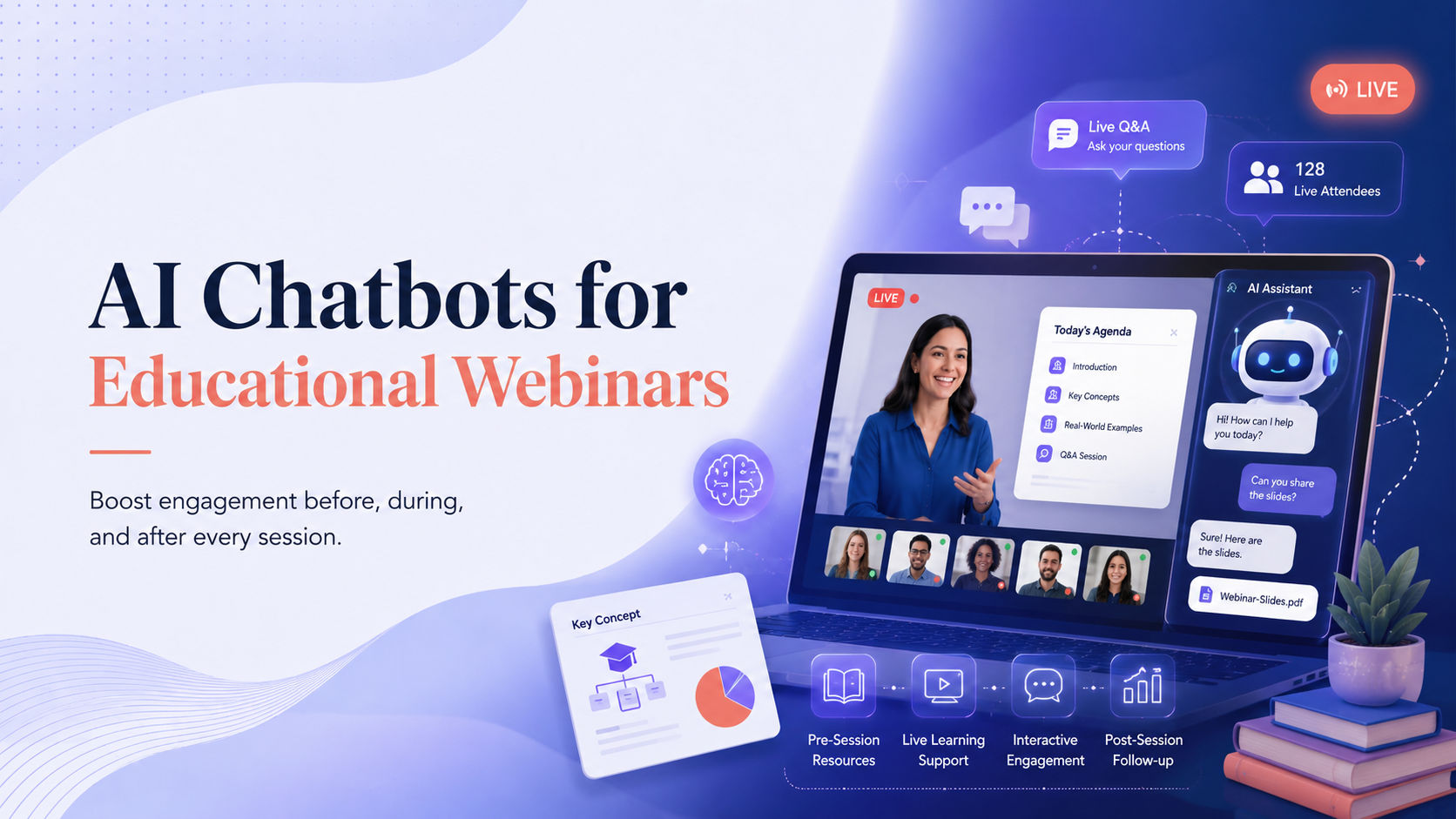
Educational webinars have moved beyond simple online presentations. For Malaysian businesses, training providers, universities, professional associations, and B2B marketing teams, webinars are now expected to generate engagement, qualify interest, support learning outcomes, and create measurable follow-up opportunities. The challenge is that most webinar formats still depend heavily on one-way delivery, manual moderation, and post-event emails that arrive too late to influence the participant's experience.
This is where **AI Chatbots for Educational Webinars** become commercially relevant. Used well, they can support participants before, during, and after a session by answering common questions, guiding attendees to the right content, collecting intent signals, and helping organisers understand which topics are driving real interest. The value is not simply automation. The value is sharper audience insight, better learning support, and more structured conversion pathways.
In 2026, the strategic question is no longer whether a chatbot can answer questions. It is whether the chatbot can strengthen the entire webinar journey. A participant may register because of a topic, attend because of a reminder, ask questions during the session, request a resource afterwards, and later become a sales lead, student applicant, member, or training prospect. Each stage contains data that can help a business improve its messaging, offers, and customer experience.
From Blackstone Consultancy's perspective, the focus should be on growth architecture rather than novelty. A chatbot should be assessed against practical business questions:
- Does it reduce friction in registration and attendance?
- Does it help participants find relevant answers without disrupting the speaker?
- Does it capture useful questions, objections, and buying signals?
- Does it segment audiences based on interests or readiness?
- Does it improve follow-up quality for sales, admissions, or marketing teams?
- Does it integrate with the organisation's CRM, email platform, or learning system?
For Malaysian organisations, this matters because audiences are increasingly selective. Decision-makers, learners, and professionals have limited time. If a webinar feels generic, passive, or poorly followed up, engagement drops quickly. A well-planned chatbot layer can make the experience feel more responsive while giving the organiser clearer evidence of what the audience actually needs.
The opportunity is not to replace educators, trainers, or presenters. It is to equip them with a digital co-host that supports scale, consistency, and commercial intelligence. When aligned with content strategy, lead management, and customer journey design, webinar chatbots can become a practical tool for improving both learning engagement and business growth.
What The Market Is Really Responding To
The strongest webinar strategy often continues through webinar-to-course chatbot pathways, where interest becomes structured learning.
Educational webinars are no longer judged only by speaker quality or slide design. Malaysian audiences are becoming more selective because they have sat through enough passive online sessions to know what feels useful and what feels like another broadcast. The growing interest in **AI Chatbots for Educational Webinars** is really a response to three commercial pressures: attention is harder to hold, participants expect faster answers, and organisers need clearer signals of buyer or learner intent.
Customers Want Guidance, Not Just Content
Webinar participants are often joining with different levels of knowledge. A business owner may want strategic implications, while a junior team member may need definitions and examples. A traditional webinar treats both audiences the same. Chatbot-assisted experiences allow participants to ask questions privately, revisit key points, request summaries, or find the most relevant resource without interrupting the session.
This matters because users are increasingly impatient with generic content. If they cannot quickly connect a webinar topic to their own problem, they leave mentally even if they stay logged in. The market is responding to learning experiences that feel more adaptive, direct, and respectful of time.
Category Signals Are Moving Toward Interaction
In education, training, professional services, and B2B marketing, the category signal is clear: audiences expect two-way engagement. Polls and Q&A boxes were once enough. Now, decision-makers are looking for webinar formats that capture questions, segment interests, qualify follow-up needs, and support participants after the session ends.
For Malaysian companies running product education, compliance briefings, franchise training, HR learning, or lead-generation webinars, this shift is commercially important. The webinar is no longer just an awareness tool. It can become a structured engagement channel that reveals what prospects care about, what objections they have, and where they are in the decision journey.
Brand Perception Depends On Responsiveness
A responsive webinar experience can make a brand feel organised, modern, and customer-aware. A poor one can make even a capable company appear outdated. When attendees ask questions and receive slow, vague, or irrelevant responses, the issue is not only operational; it affects trust.
This is where marketing teams need to think beyond technology adoption. The chatbot's tone, escalation path, content accuracy, and alignment with brand messaging all influence perception. It should support the facilitator, not replace the credibility of the expert.
Commercial Intent Comes From Better Follow-Up
The real value often appears after the webinar. Chatbot interactions can help identify which attendees asked pricing-related questions, requested implementation guidance, or showed interest in specific services. That makes follow-up more relevant for sales teams and more useful for the customer.
For stronger results, webinar strategy should connect with content, email, retargeting, and social distribution. Working with a social media agency can help businesses turn webinar engagement into a wider campaign rather than a one-off event.
The Strategic Pattern Beneath The Surface
After the session, post-webinar skill assessment bots can help teams test whether the audience understood the key ideas.
The surface story is that webinar chatbots make online learning more interactive. The deeper commercial pattern is more important: they change how an education offer is positioned, discovered, evaluated, and converted.
For Malaysian training providers, universities, consultants, software vendors, and professional education brands, the webinar is no longer just a delivery format. It is becoming a live decision environment. Participants arrive with different levels of awareness, urgency, language preference, and buying intent. The organisations that read these signals well can design better sessions, stronger follow-up, and clearer commercial pathways.
From Information Delivery To Guided Decision-Making
The old webinar model assumes that everyone needs the same presentation. A speaker explains, a moderator filters questions, and the sales team follows up later. That structure often hides useful intent signals inside chat logs, Q&A threads, attendance duration, and unanswered objections.
A more strategic approach treats AI Chatbots for Educational Webinars as part of the offer design. The chatbot does not simply answer routine questions. It helps identify what the audience is trying to solve. Are they exploring a topic for the first time? Comparing vendors? Seeking certification? Looking for implementation support? Each answer changes the next best action.
This matters because positioning becomes sharper when it is based on live audience behaviour rather than assumptions.
Search Demand Reveals The Buying Stage
Search behaviour around educational webinars usually contains mixed intent. Some users want free learning. Others want proof that a provider understands their industry. Some are already evaluating whether to attend, register, request a demo, or speak to a consultant.
This means content cannot only promote the webinar. It must answer the questions people ask before they trust the event: who it is for, what level it covers, what outcomes are realistic, whether local context is included, and what happens after registration.
For Malaysian brands, this also affects language, examples, and proof. A generic global webinar may feel polished but distant. A locally relevant webinar that addresses Malaysian business constraints, compliance concerns, budget cycles, and operational realities will usually feel more useful.
Conversion Behaviour Is A Learning Signal
Registrations, attendance, replay views, poll responses, and chatbot questions should not be treated as separate metrics. Together, they show where interest strengthens or drops.
If many participants ask about pricing, the offer may need clearer packaging. If they ask basic questions, the content may be attracting a top-of-funnel audience. If they ask implementation questions, the sales follow-up should move quickly and practically.
The strategic pattern is simple: insight should reduce guesswork. The best webinar systems do not just educate the market. They help the business understand what the market is ready to do next.
Audience, Message, And Channel Fit
For internal audiences, employee webinar communication bots can keep reminders, materials, and follow-up actions clear.
For Malaysian education providers, training companies, universities, HR teams, and professional bodies, the value of webinar automation is not the same for every buyer. A stronger strategy starts by separating the audience by decision stage, not simply by job title. Someone exploring AI Chatbots for Educational Webinars for the first time needs clarity and reassurance; someone comparing vendors needs proof, integration details, and governance confidence.
Segment The Audience By Buying Intent
Problem-aware buyers are usually feeling operational pressure. They may be running webinars with low engagement, repeated questions, weak follow-up, or limited post-event insight. For this group, the message should focus on practical pain points: reducing moderator load, improving learner support, capturing questions, and helping attendees find relevant information faster.
Comparison-stage buyers are more analytical. They may already believe chatbot support is useful but need to decide whether it fits their platform, budget, data policies, and learner experience. They respond better to implementation roadmaps, feature comparisons, security explanations, and examples of how the chatbot supports registration, live Q&A, post-webinar summaries, and follow-up journeys.
Existing customers need a different message again. If they already attend webinars or use your learning platform, the message should not sound like a technology announcement. It should explain how the experience becomes easier: quicker answers, personalised reminders, clearer resources, and more convenient learning support before, during, and after the session.
Internal stakeholders, including management, IT, compliance, sales, and academic teams, need business justification. Their attention is earned through risk control, operational efficiency, reporting visibility, brand consistency, and a clear rollout plan.
Match The Message To The Channel
For early awareness, LinkedIn posts, short insight articles, email newsletters, and webinar invitations work well because they frame the issue without forcing an immediate sales conversation. The message should be educational: what is changing, why attendee expectations are rising, and where manual webinar operations create friction.
For evaluation, use deeper assets such as implementation guides, demo videos, FAQ pages, comparison sheets, and consultation-led landing pages. These channels should answer commercial questions directly: cost factors, integration requirements, training needs, language support, data handling, and how success will be measured.
For conversion, direct sales conversations, private demos, pilot proposals, and stakeholder workshops are more effective. At this point, the message should be specific to the buyer's learner journey, webinar format, and internal systems.
For retention, use onboarding emails, in-platform prompts, post-event reports, and customer success reviews. The goal is to show continuous improvement, not just launch a chatbot and leave it unmanaged.
What Malaysian Businesses Can Apply
A webinar can also support retention when webinar loyalty nurturing flows keep interested users engaged beyond the event day.
AI-enabled webinar experiences are not only relevant to universities, training providers, or education platforms. Malaysian businesses can apply the same thinking to lead generation, customer education, product launches, recruitment briefings, and community-building campaigns. The practical opportunity is to turn webinars from one-way presentations into guided, data-informed engagement assets.
Treat Webinars as Part of the Marketing Funnel
Many businesses still run webinars as standalone events: promote, present, follow up, then move on. A stronger approach is to connect each webinar to a wider digital marketing plan. Before the session, chatbot-assisted registration can qualify attendees by interest, industry, location, or buying stage. During the session, an AI assistant can help answer common questions, direct users to relevant resources, and collect intent signals. After the session, the same data can inform email nurturing, retargeting audiences, sales call priorities, and content planning.
For Malaysian SMEs, this is especially useful when teams are lean. Instead of relying only on manual follow-up, marketing teams can create structured pathways for different attendee types, such as prospects, partners, students, franchise applicants, or existing customers.
Use Social Media to Drive Smarter Participation
A social media agency should not only promote the webinar date and speaker. It should design the full audience journey. Short-form teaser videos, LinkedIn posts, Instagram Stories, Facebook event reminders, and WhatsApp broadcast flows can all lead into a webinar experience where questions are captured and segmented.
For example, a property developer hosting a buyer education session could identify whether attendees are first-time buyers, investors, or upgraders. A B2B software company could separate technical users from decision-makers. A training provider could identify HR managers versus individual learners. This allows post-webinar content to be more relevant, instead of sending the same generic message to everyone.
Turn Questions into Content and Campaign Ideas
One practical advantage of AI Chatbots for Educational Webinars is the ability to organise audience questions into themes. Malaysian marketing teams can review recurring concerns and use them to produce social posts, blog articles, FAQ pages, explainer videos, email sequences, and sales enablement material.
This creates a useful feedback loop. The webinar educates the audience, the audience reveals what they care about, and the business turns those insights into future campaigns. Over time, this improves messaging quality and helps brands speak more directly to real customer objections.
Start Simple, Then Build Integration
Businesses do not need a complex system on day one. Start with clear registration fields, a moderated Q&A workflow, a post-event tagging process, and a simple follow-up sequence. Once the webinar model proves useful, integrate CRM data, paid media retargeting, marketing automation, and sales reporting.
The goal is not to replace human presenters or sales teams. It is to make every webinar more interactive, measurable, and commercially useful.
Measurement That Keeps The Strategy Honest
Teams should review webinar journey analysis signals to see whether registrations, attendance, questions, and follow-ups are connected.
A webinar chatbot should not be judged by novelty. It should be judged by whether it helps the right audience find, attend, understand, enquire, and move forward with confidence. For Malaysian education providers, training companies, B2B brands, and professional service firms, measurement is what separates a useful learning asset from an expensive digital gimmick.
Search Signals: Are You Attracting The Right Learners?
Start with search intent. Track which queries bring visitors to the webinar page, registration page, replay hub, and related article content. For a topic such as **AI Chatbots for Educational Webinars**, the goal is not simply to rank for broad AI terms. The stronger signal is whether visitors arrive with intent around learning delivery, training automation, webinar engagement, course enquiries, or internal upskilling.
Useful metrics include impressions, click-through rate, ranking movement, scroll depth, registration conversion rate, and assisted conversions from organic search. Review whether the chatbot is answering the same questions users searched for, or whether there is a gap between the search promise and the webinar experience.
Engagement Quality: Are People Learning Or Just Clicking?
Chat volume alone can be misleading. A busy chatbot is not necessarily an effective one. Look at the quality of interactions: repeated clarification questions, topic drop-offs, completion of quizzes, replay section clicks, resource downloads, and whether users ask deeper follow-up questions after key segments.
For educational webinars, strong engagement often appears as purposeful behaviour. Participants request examples, compare options, ask for slides, revisit timestamps, or submit questions tied to business implementation. These signals are more useful than vanity metrics such as total messages sent.
Lead Quality: Are Enquiries Commercially Meaningful?
Marketing teams should connect chatbot activity to CRM outcomes. Which webinar questions tend to precede a sales conversation? Which resources are downloaded before a serious enquiry? Which attendee segments request pricing, implementation timelines, HRDF-related details, demos, or customised training?
This helps separate casual learners from potential buyers. A smaller number of well-qualified leads is usually more valuable than a large list of passive attendees who never progress.
Operational Signals: Is The System Sustainable?
Measure the internal workload too. Track unresolved questions, escalation frequency, repeated content gaps, response accuracy reviews, and the time needed to maintain webinar knowledge bases. If the chatbot creates more manual correction than value, the strategy needs refinement.
Review Loops: Make Improvement Routine
Set a monthly or post-webinar review. Combine search data, engagement logs, sales feedback, and support observations. Identify what content should be updated, which questions deserve new webinar segments, and which chatbot prompts need tightening. This loop keeps the strategy commercially grounded and prevents teams from copying visible market tactics without understanding whether they actually serve the audience.
Risks, Trade-Offs, And Better Questions
AI can make webinars feel more responsive, but it can also create new problems if teams implement it because competitors are doing so. For Malaysian businesses, training providers, universities, and B2B marketing teams, the goal is not to look advanced. The goal is to improve attendance quality, learning outcomes, sales follow-up, or customer education without damaging trust.
Avoid Copying The Most Visible Tactic
A chatbot that answers every question instantly may look impressive in a demo, but it may not be the right move for every webinar. Some audiences need speed. Others need accuracy, cultural sensitivity, or a clear route to a human expert.
Before copying a visible feature, ask:
- Does this improve the participant's decision-making, or only reduce our workload?
- What happens when the chatbot gives an incomplete or outdated answer?
- Which questions should be answered by AI, and which should be escalated to a trainer, adviser, or sales consultant?
- Will participants know when they are interacting with automation?
- Can the system handle Bahasa Malaysia, English, mixed-language questions, and industry-specific terms properly?
For AI Chatbots for Educational Webinars, the biggest risk is often not technical failure. It is a mismatch between automation and the audience's real expectations.
Keep The Commercial Case Clear
Every added feature has a cost: setup, training data preparation, platform integration, moderation, compliance review, and ongoing improvement. If the webinar supports lead generation, onboarding, product education, or professional training, define the business case before buying tools.
Useful commercial questions include:
- Are we trying to increase registrations, completion, qualified leads, renewals, or post-event engagement?
- What information must be captured to support sales or customer success?
- How will we measure whether the chatbot improved the webinar rather than simply adding novelty?
- Who owns the follow-up process after the event?
- What budget is justified if the webinar only runs once, compared with a recurring programme?
A modest chatbot that handles FAQs, directs users to the right resources, and flags high-intent participants may be more valuable than a complex assistant with features nobody maintains.
Build Trust Before Expanding Automation
Start with a controlled scope. Use approved content, clear escalation rules, and post-webinar review. Check unanswered questions, incorrect responses, repeated confusion, and missed commercial opportunities. These insights are often more useful than the webinar recording itself.
The better question is not "How intelligent can the chatbot be?" It is "Where can automation support a better learning and buying journey without weakening confidence?"
A Practical Roadmap For Turning The Insight Into Action
Tourism and destination brands can adapt the same model through travel webinar enquiry chatbots when webinars drive planning questions.
For Malaysian business owners and marketing teams, the opportunity is not simply to "add a chatbot" to a webinar. The real value comes from designing a better learning journey: clearer registration, stronger attendance, more relevant interaction, and more useful follow-up. The next planning cycle should focus on practical steps that connect insight, technology, content, and commercial outcomes.
1. Define The Business Role Of The Webinar
Start by clarifying what each webinar is meant to achieve. Is it for lead generation, customer education, partner training, product onboarding, or thought leadership? The answer will determine how the chatbot should behave.
For example, a prospecting webinar may require qualification questions and sales routing. A customer education session may need guided FAQs, resource recommendations, and post-session support. Without this clarity, AI Chatbots for Educational Webinars can become an extra feature rather than a business tool.
2. Map The Learner Journey Before Selecting Tools
Document the full journey from invitation to post-event follow-up. Identify where participants commonly drop off, repeat questions, or need assistance. This will reveal where automation can reduce friction.
Key points to review include:
- Registration and reminder communication
- Pre-webinar questions and content expectations
- Live Q&A and moderation requirements
- Polls, quizzes, or knowledge checks
- Follow-up resources and sales handover
- Reporting for marketing, training, or management teams
The goal is to automate the right moments, not every moment.
3. Build A Small, Governed Pilot
Before rolling out across all webinars, run a controlled pilot with one audience segment and one defined objective. Prepare approved answer sources, escalation rules, data handling guidelines, and fallback responses when the chatbot cannot answer confidently.
For Malaysian organisations, governance is especially important when dealing with customer data, regulated industries, education records, or internal training content. Marketing teams should work with IT, compliance, sales, and subject-matter experts before launch.
4. Measure Decisions, Not Vanity Metrics
Attendance and chat volume are useful, but they are not enough. Track whether the chatbot improves decision-making and next-step action.
Practical measures may include:
- Fewer repeated basic questions during live sessions
- Better segmentation of attendees by interest or readiness
- More relevant follow-up emails and sales conversations
- Clearer content gaps for future webinars
- Improved participant completion of learning activities
5. Turn Each Webinar Into A Learning Asset
After every session, review chatbot queries, unanswered questions, poll responses, and engagement patterns. These insights can shape future blog topics, sales enablement materials, FAQ pages, product explainers, and training modules.
The leadership question is simple: what did the audience reveal that should change our next decision? That is where webinar technology becomes a strategic insight engine, not just an event support tool.