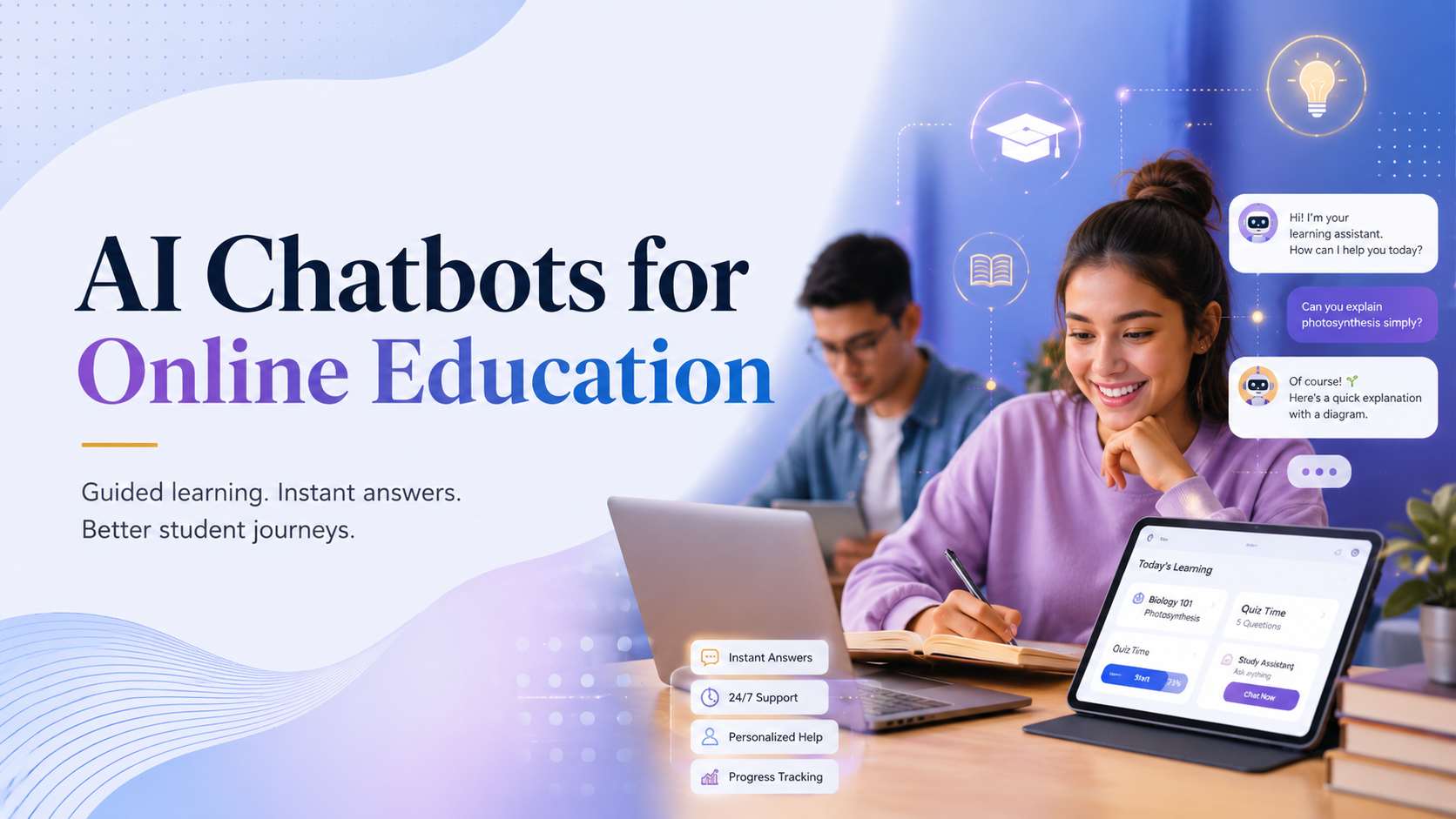
Online education is no longer a temporary substitute for classrooms. For universities, training providers, professional academies, tuition centres, and corporate learning teams in Malaysia, digital learning has become a commercial channel, a student support model, and a brand experience. The next competitive question is not simply whether lessons can be delivered online, but whether learners can be guided, supported, and retained at scale. This is where AI Chatbots for Online Education are becoming strategically important.
For business owners and marketing teams, the chatbot conversation should not start with technology. It should start with growth. Where are prospective students dropping off? Which questions delay enrolment? What support issues consume staff time? Which learner segments need more personalised guidance? A chatbot that only answers basic FAQs may reduce admin workload, but a well-planned chatbot can support lead qualification, course recommendation, onboarding, learning assistance, and post-course engagement.
In 2026, AI Chatbots for Online Education are relevant because learners expect faster responses, clearer pathways, and more flexible support. A working adult comparing diploma programmes at night does not want to wait until office hours. A parent considering an online tuition package may need reassurance before making payment. A corporate HR manager evaluating training vendors may want instant details on syllabus, outcomes, pricing structure, and implementation timelines. These are commercial moments, not just service enquiries.
Blackstone Consultancy would analyse this topic from a strategic growth perspective by looking at three connected areas: demand, experience, and conversion. Demand analysis identifies what students and buyers are searching for, what pain points appear repeatedly, and which course categories are most commercially viable. Experience analysis reviews how easy it is for users to get answers, compare options, and move from interest to action. Conversion analysis examines whether the chatbot is helping the business capture enquiries, segment prospects, and create measurable next steps.
AI Chatbots for Online Education should also be assessed through a Malaysian market lens. Language preferences, mobile-first behaviour, trust signals, payment confidence, accreditation concerns, and WhatsApp-driven communication habits can all influence adoption. A chatbot strategy that works for a global edtech platform may not fit a local training provider serving SMEs, parents, or working professionals.
The opportunity is practical: use AI Chatbots for Online Education to reduce friction, improve learner support, and create better commercial intelligence. The risk is treating the chatbot as a novelty rather than an integrated growth asset. For education brands, AI Chatbots for Online Education should be planned as part of the wider marketing, admissions, customer experience, and retention strategy-not as a standalone widget.
What The Market Is Really Responding To
For education providers handling vulnerable learners, student wellbeing triage chatbot design is part of the same trust discussion.
The demand behind **the company** is not only about technology adoption. It reflects a broader shift in how students, parents, working adults, and institutions expect learning support to be delivered: faster, more personalised, and available beyond office hours.
Customer Behaviour: Learners Expect Immediate Support
Online learners are now less tolerant of slow replies, unclear course instructions, and generic learning journeys. Whether they are university students, corporate trainees, or parents comparing enrichment programmes, they often look for quick answers before committing. If a platform cannot respond promptly, users may move to another provider that feels easier to deal with.
For Malaysian education businesses, this matters at every stage of the funnel. Prospects may ask about fees, schedules, entry requirements, language options, accreditation, trial classes, or payment plans. Existing learners may need help with assignments, lesson access, reminders, or technical issues. **the brand** are gaining attention because they can support these touchpoints without forcing every enquiry into a manual customer service queue.
Category Signals: Convenience Is Becoming A Differentiator
The market is responding to education brands that reduce friction. A strong course is still essential, but the surrounding experience now affects trust. Clear onboarding, instant FAQs, guided course selection, and timely follow-ups all influence whether a learner completes registration or drops off.
This is also why marketing teams should not view chatbots as a standalone tool. They work best when connected to content strategy, landing pages, WhatsApp flows, CRM processes, and remarketing. A social media agency can help align chatbot messaging with campaign intent, so paid traffic and organic enquiries are handled with consistent positioning.
Brand Perception: Smart Support Builds Confidence
The brands winning attention around **the market example** are not necessarily the ones using the most advanced language model. They are the ones that make the learner feel understood. A chatbot that gives accurate guidance, uses the right tone, and escalates sensitive queries to humans can strengthen credibility.
For schools, colleges, training providers, and edtech companies, brand perception depends on reliability. If automation feels careless, it damages trust. If it feels helpful and well-governed, it signals professionalism.
Commercial Intent: From Curiosity To Conversion
Commercial intent around **the operator** is strongest where there is pressure to handle more enquiries, reduce response delays, improve enrolment conversion, or support learners at scale. Decision-makers are not buying "AI" for novelty; they are looking for operational leverage.
In short, **this business** are becoming commercially relevant because they sit at the intersection of customer experience, lead conversion, learner retention, and brand trust.
The Strategic Pattern Beneath The Surface
A learning platform that wants better progression can pair course guidance with learner skill-check automation before users fall behind.
The opportunity is not simply that education providers can add a chatbot to their website or learning platform. The bigger pattern is that **the company** sit at the intersection of positioning, offer design, content strategy, search demand, and conversion behaviour. For Malaysian training providers, colleges, edtech firms, and professional course brands, this matters because buyers are no longer only comparing course titles. They are comparing responsiveness, clarity, guidance, and confidence before they enquire.
Positioning Moves From "Course Provider" To "Learning Support System"
A chatbot changes what a brand can credibly promise. Instead of positioning around course access alone, providers can emphasise guided learning, faster answers, personalised pathways, and better learner support. This is commercially important in Malaysia, where audiences may include school leavers, working adults, HR teams, parents, and international students, each with different concerns.
The strongest positioning is not "we use AI". It is "we help learners make better decisions and stay supported throughout the journey". **the brand** should therefore be framed as part of a learning experience, not a novelty feature.
Offer Design Becomes More Conversational
Many education pages still present offers in a static way: programme overview, fees, duration, entry requirements, and a form. That structure is useful, but it does not match how people actually decide. Prospects ask sequential questions: Is this suitable for me? Can I study while working? Is it recognised? What happens after payment? Can my company sponsor it?
A well-planned chatbot reveals these decision paths. It can also help marketing teams redesign offers into clearer bundles, pathways, comparisons, and next-step prompts. In this sense, **the market example** are not only a support tool; they are a research tool for understanding friction.
Content And Search Demand Become More Intent-Led
Search demand around online education is often practical: fees, eligibility, certificates, schedules, career outcomes, comparisons, and support. The content strategy should reflect those real questions rather than only publishing broad educational articles.
When chatbot conversations and search queries are reviewed together, patterns become clearer. **the operator** can highlight gaps between what the brand explains and what prospects still need to know. Those gaps can become FAQ sections, landing page improvements, email sequences, webinar topics, and sales scripts.
Conversion Behaviour Depends On Confidence
In education, conversion is rarely instant. People hesitate because the decision affects money, time, career direction, or family expectations. The chatbot's role is to reduce uncertainty without applying pressure. It should guide users to the right course, clarify requirements, explain next steps, and hand over to a human advisor when needed.
For Malaysian businesses, the strategic question is not whether **this business** can answer questions. The better question is whether the chatbot improves the buyer journey in a measurable way: better enquiries, fewer repeated questions, clearer segmentation, faster follow-up, and more informed prospects. That is where the commercial value sits.
Audience, Message, And Channel Fit
The internal audience matters too, especially when universities or academies use campus staff communication bots to support course operations.
For Malaysian education providers, training companies, and edtech teams, **the company** should not be positioned as a novelty. The stronger commercial angle is operational clarity: faster learner support, better course guidance, reduced admin burden, and a more consistent digital experience across enrolment, study, and completion.
Segment The Audience By Decision Pressure
Not every buyer is looking for the same proof. A parent comparing tuition platforms may care about responsiveness and learning support. A working adult choosing a professional course may want flexible guidance outside office hours. A university department may focus on student services, compliance, and integration with existing systems. A business owner or marketing lead will usually ask whether **the brand** can reduce repetitive enquiries while improving conversion quality.
This means the message should change by segment. Problem-aware audiences need simple explanations of what the chatbot solves. Comparison-stage buyers need feature clarity, implementation confidence, and risk reduction. Existing students or customers need reassurance that the chatbot helps them complete tasks faster, not blocks access to human support. Internal stakeholders need evidence that the tool supports service quality, not just cost control.
Match The Message To The Buying Stage
At the awareness stage, the best message is practical: "Get course answers, timetable guidance, payment information, and learning support without waiting for office hours." Avoid overclaiming that the chatbot replaces tutors or academic advisors.
At comparison stage, **the market example** need proof around accuracy controls, escalation rules, multilingual capability, CRM or LMS integration, reporting, and data handling. Malaysian teams should also consider whether the experience works well across English, Bahasa Malaysia, and other learner-preferred languages where relevant.
At decision stage, the message should become more operational: implementation timeline, content preparation, team responsibilities, support workflows, and how success will be reviewed.
Choose Channels That Support Trust
Search content works well for problem-aware audiences because they are actively researching solutions. Landing pages and comparison pages help buyers evaluate fit. Webinars, demos, and sales decks are stronger for decision committees because they allow objections to surface early.
Existing customers respond when **this business** are framed through email, in-platform prompts, WhatsApp notices, and onboarding guides. Internal stakeholders need to see how **the operator** fit into service processes, reporting routines, and escalation paths before they will support adoption.
What Malaysian Businesses Can Apply
For live classes or launches, webinar follow-up chatbot flows can extend the learning experience after the session ends.
The rise of the company is not only relevant to universities, tuition platforms, and training providers. It also shows how Malaysian businesses can use automated, personalised conversations to improve marketing, customer education, lead qualification, and post-sale engagement.
Turn Education Into a Marketing Asset
Many businesses already explain products repeatedly through WhatsApp, social media comments, sales calls, and email. A chatbot can convert those repeated explanations into guided learning journeys.
For example, a property developer can educate buyers on financing steps, a healthcare brand can explain service preparation, and a B2B software company can guide prospects through use cases. This is where the brand offer a useful model: answer common questions, adapt to the user's level of understanding, and move them towards the next action.
For Malaysian brands, this should not replace human sales teams. It should reduce repetitive enquiries so teams can focus on qualified conversations.
Connect Chatbots With Social Media Campaigns
A social media agency should not treat chatbot deployment as a standalone tool. It should be linked to campaign strategy, content planning, and lead nurturing.
When a user clicks a Facebook, Instagram, TikTok, or LinkedIn ad, the chatbot can continue the conversation instantly. Instead of sending every prospect to a static landing page, businesses can create interactive flows that ask about needs, budget, location, timeline, or preferred service.
For training providers, the market example can support course discovery, explain programme differences, suggest suitable learning paths, and remind users about registration deadlines. This makes social traffic more actionable and gives marketers better insight into audience intent.
Use Chatbot Insights to Improve Content
Chatbot conversations reveal what people do not understand. These questions can become blog topics, short-form videos, carousel posts, email sequences, FAQ pages, and sales scripts.
When promoted through social media, the operator should be positioned around convenience, guidance, and clarity-not just technology. Malaysian audiences are practical. They want to know whether the tool helps them decide faster, learn easier, or get support without waiting.
A strong digital marketing strategy should therefore connect chatbot data with SEO, paid ads, remarketing, and social content calendars.
Start Small, Then Expand
A useful approach is to position this business as a pilot, not a massive transformation project. Begin with one high-friction area: course enquiries, onboarding, product education, appointment booking, or customer FAQs.
Before investing heavily in the company, businesses should define clear conversation goals, escalation rules, brand tone, compliance requirements, and measurement points. The best results come when automation supports a real commercial process, not when it is added simply because AI is trending.
Measurement That Keeps The Strategy Honest
Measurement becomes clearer when student journey chatbot analysis shows where learners hesitate, repeat questions, or drop out.
A serious strategy for **the brand** should not be judged by novelty alone. Malaysian education brands, training providers, and EdTech teams need a measurement model that shows whether the chatbot is improving discovery, learner confidence, enquiry quality, and operational efficiency.
Search Signals: Is Demand Growing In The Right Places?
Start with search visibility. Track rankings for course-related, problem-led, and comparison keywords-not only broad chatbot terms. Useful indicators include impressions, click-through rate, landing page engagement, and whether users move from informational pages to programme pages.
For **the market example**, search data should answer practical questions: Are users looking for 24/7 study support, admissions guidance, Bahasa Malaysia assistance, corporate learning help, or assessment preparation? These patterns help teams refine content, chatbot scripts, and campaign targeting.
Engagement Quality: Are Users Actually Helped?
Traffic is not enough. Measure the quality of chatbot interactions. Look at completion rate, unanswered question rate, repeat queries, conversation length, escalation requests, and satisfaction prompts. A short conversation can be successful if the learner gets a direct answer. A long one may signal confusion.
Review transcripts regularly to identify missing content, unclear pricing, weak course descriptions, or gaps in academic support information. This is where **the operator** becomes more than a front-end tool; it becomes a feedback system for improving the whole digital learning experience.
Lead Quality: Are Enquiries Commercially Useful?
Marketing teams should separate general curiosity from serious intent. Track chatbot-assisted leads by source, course interest, budget fit, decision timeline, location, and qualification status. For corporate training, include company size, department, required learning outcomes, and procurement stage.
If **this business** generates many enquiries but few enrolments, the issue may be targeting, offer clarity, pricing expectation, or follow-up speed. The measurement should expose the bottleneck, not simply celebrate volume.
Operational Signals: Is The Team Working Better?
A chatbot should reduce avoidable workload without damaging trust. Measure support ticket reduction, response time, handover accuracy, duplicate question frequency, and the number of conversations that require human intervention. In Malaysia's multilingual market, also assess whether responses handle language preferences and local context appropriately.
Review Loops: Make Improvement Routine
Set a monthly review rhythm. Combine search performance, chatbot data, CRM outcomes, and learner feedback into one dashboard. Assign owners for content updates, script refinement, admissions follow-up, and technical fixes.
The strongest use of **the company** is not a one-time launch. It is a repeatable process: measure, interpret, improve, and test again.
Risks, Trade-Offs, And Better Questions
Before investing in **the brand**, Malaysian education providers, training companies, and corporate learning teams should be clear about one thing: the technology is not a strategy by itself. A chatbot can reduce friction, improve learner support, and make content easier to navigate, but it can also expose weak course design, unclear ownership, and poor data governance.
Do Not Copy The Tactic Without Understanding The Context
A visible success story about **the market example** may be built on factors that your organisation does not have: a large content library, mature student support processes, strong CRM integration, or an internal team that continuously improves the bot. Copying the interface is easy. Copying the operating model is harder.
Before adopting a similar approach, ask:
- What learner problem are we solving first: onboarding, revision, support, lead conversion, or retention?
- Is the chatbot helping users reach a better answer, or merely giving faster but shallow responses?
- Who owns accuracy, escalation, compliance, and content updates?
- What happens when the bot gives an incomplete, outdated, or culturally inappropriate answer?
- Will the system support Bahasa Malaysia, English, Mandarin, or Tamil where needed?
Watch The Commercial Trade-Offs
the operator should not be judged only by novelty. They should be evaluated against practical commercial outcomes: lower support workload, better enrolment journeys, improved course completion, stronger learner satisfaction, or more efficient sales qualification.
The risk is spending on features that look advanced but do not affect revenue, learner trust, or operational cost. For example, a chatbot that answers hundreds of generic questions may still fail commercially if it cannot guide a parent, student, or HR buyer toward the right programme.
Keep Humans In The Loop
The commercial case for this business becomes stronger when teams define where automation stops. Sensitive issues such as fees, refunds, accreditation, grades, visa-related guidance, and learner complaints often need human review. A well-designed system should escalate smoothly instead of pretending to solve everything.
Better Questions To Ask Before Launch
When the company are treated as a business capability rather than a marketing gimmick, the discussion improves. Ask how the chatbot will be trained, measured, audited, and improved over time. More importantly, ask whether the learner experience becomes clearer, faster, and more trustworthy. If the answer is uncertain, fix the strategy before scaling the tool.
A Practical Roadmap For Turning The Insight Into Action
Longer programmes should also consider education retention chatbot journeys when the goal is continued participation, not only first enrolment.
The opportunity is not to "add a chatbot" and hope engagement improves. For Malaysian education providers, training companies, and marketing teams, the more useful approach is to treat the brand as a structured business initiative: one that connects learner needs, enrolment goals, teaching operations, and measurable service quality.
1. Define The Commercial Problem First
Start with one priority for the next planning cycle. Is the issue slow enquiry response, weak lead nurturing, poor course completion, overloaded support teams, or inconsistent learner guidance? A chatbot strategy should be attached to a business problem that leadership already cares about.
For example, the market example may support prospective students by answering programme questions, helping compare course pathways, or prompting them to book a consultation. For existing learners, the same technology may guide onboarding, explain assessment steps, or direct students to the right academic or administrative contact.
2. Map The Learner Journey Before Selecting Tools
Before reviewing platforms, document the learner journey from awareness to enrolment, onboarding, study support, assessment, renewal, or graduation. Identify repeated questions, decision delays, and service bottlenecks.
This helps the team decide where the operator should sit: website, WhatsApp, LMS, student portal, email follow-up, or internal support desk. The best channel is not always the newest one; it is the channel your audience already uses when they need help.
3. Build A Pilot With Clear Boundaries
Choose one controlled use case for the first rollout. Keep the knowledge base focused, the escalation path clear, and the tone aligned with your institution or brand. this business should not replace academic judgement, admissions counselling, or sensitive student support. They should handle routine guidance and know when to pass the conversation to a human.
4. Measure Decisions, Not Just Conversations
Avoid vanity metrics such as message volume alone. Track whether the chatbot improves enquiry qualification, reduces repeated support requests, increases consultation bookings, shortens response time, or improves completion of key learner actions.
Marketing teams should also review conversation data to understand language patterns, content gaps, and objections. These insights can improve landing pages, FAQs, email sequences, webinar topics, and sales scripts.
5. Review, Govern, And Scale Responsibly
Set a monthly review rhythm involving marketing, admissions, academic, IT, and operations. Update answers, remove weak flows, check compliance risks, and review escalation quality. Once the pilot is stable, expand gradually.
Used well, the company become more than a digital assistant. They become a practical signal system for what learners need, what prospects hesitate over, and where the business must improve next.