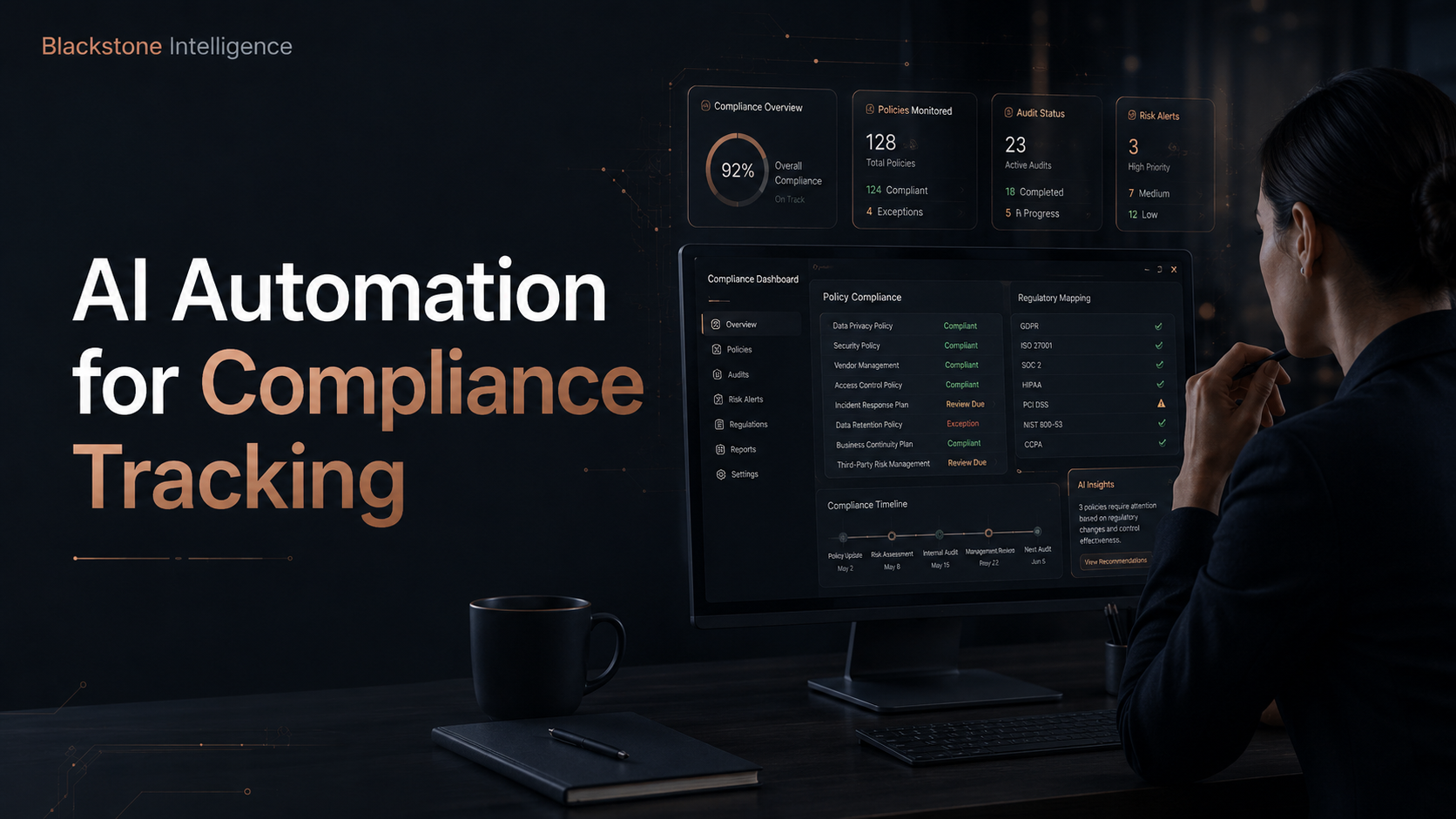
Regulatory pressure is no longer a back-office concern that can be reviewed once a year and filed away. For Malaysian businesses, compliance now touches customer data, advertising claims, financial controls, procurement, employment practices, ESG expectations, platform governance, and sector-specific licensing requirements. As companies digitise operations and expand across channels, the risk is not only failing to comply, but failing to notice non-compliance early enough to correct it commercially.
This is where **AI Automation for Compliance Tracking** becomes a strategic business issue rather than a purely technical one. The value is not in replacing legal, finance, risk, or management teams. The value is in giving decision-makers faster visibility over changes, exceptions, patterns, and operational gaps that may otherwise remain hidden across emails, spreadsheets, systems, contracts, campaign assets, and internal workflows.
For business owners, the question is practical: where are we exposed, what must be monitored, who is accountable, and how quickly can we respond? For marketing teams, the question is just as important: are claims, promotions, customer journeys, consent mechanisms, influencer activity, and data usage aligned with internal policies and external requirements? In a competitive environment, growth depends on speed, but speed without control can create reputational and financial risk.
Blackstone Consultancy would analyse this topic from a strategic growth perspective by looking beyond software adoption. The first layer is business relevance: which compliance areas directly affect revenue, customer trust, market access, or operational continuity? The second layer is workflow design: where can automation reduce manual checking, improve audit readiness, and support consistent decision-making? The third layer is governance: what should remain under human approval, how should exceptions be escalated, and how can leadership maintain oversight without slowing the organisation down?
The most useful approach is not to automate everything at once. It is to identify high-risk, high-frequency compliance activities where better monitoring can produce clear commercial benefits. Examples may include reviewing marketing content against approved claims, tracking policy acknowledgements, flagging unusual vendor documentation, monitoring data-handling processes, or maintaining evidence for internal and external reviews.
In 2026 and beyond, companies that treat compliance as a strategic operating capability will be better positioned to grow with confidence. AI can support that shift, but only when it is applied with clear business priorities, accountable ownership, and a realistic understanding of risk.
What The Market Is Really Responding To
For Malaysian businesses, the interest in **AI Automation for Compliance Tracking** is not being driven by technology curiosity alone. It is being driven by pressure: tighter regulatory expectations, faster customer scrutiny, more complex digital operations, and less tolerance for preventable mistakes.
Business owners are not simply asking, "Can AI help us comply?" They are asking, "Can it reduce the risk of being caught late, responding slowly, or looking careless in public?"
Customers Expect Proof, Not Promises
Across sectors such as financial services, healthcare, education, property, logistics, and professional services, customers are becoming more alert to how companies handle data, disclosures, claims, pricing, and service commitments. They may not use the language of compliance, but they notice inconsistencies.
A customer who sees one promise in an advertisement, another in a sales conversation, and a different condition in the contract is less likely to treat it as a small oversight. They may see it as a trust issue.
This is where compliance tracking becomes commercially important. It protects more than internal procedures. It protects how the brand is experienced across websites, social content, sales decks, WhatsApp messages, proposals, and customer service replies.
Category Signals Are Becoming More Visible
In many industries, compliance maturity is now part of the buying signal. Procurement teams, enterprise clients, banks, regulators, investors, and franchise partners increasingly look for signs that a business is controlled, documented, and consistent.
These signals may include:
- Clear approval processes for public-facing claims
- Updated privacy and data handling practices
- Consistent terms across marketing and sales materials
- Records of who approved what, and when
- Faster correction of outdated or risky content
For marketing teams, this matters because campaigns are no longer judged only by reach, leads, or conversion. They are also judged by whether the message is accurate, defensible, and aligned with business obligations.
Brand Perception Depends On Operational Discipline
A strong brand is not built only through creative work. It is reinforced by reliability. When a company communicates consistently, responds responsibly, and avoids careless claims, the market reads that as professionalism.
This is especially relevant for businesses investing in digital visibility through content, paid media, influencer activity, and social platforms. A campaign handled by a capable social media agency still needs internal guardrails so speed does not create reputational exposure.
Commercial Intent Is Moving From Awareness To Action
The market is shifting from general interest in AI to specific buying intent around risk reduction, workflow control, audit readiness, and faster review cycles. Decision-makers want tools that fit into daily operations, not experimental dashboards that sit outside the business.
The commercial opportunity belongs to companies that can show they take compliance seriously without slowing growth. In 2026, that balance is becoming a competitive advantage.
The Strategic Pattern Beneath The Surface
The visible story is that businesses want better tools for compliance. The deeper pattern is more commercial: Malaysian companies are trying to reduce uncertainty before it becomes cost, delay, reputation damage, or operational friction. This is why interest in AI Automation for Compliance Tracking is not only a technology trend. It reflects a shift in how decision-makers evaluate risk, vendors, internal processes, and accountability.
Search Demand Shows A Practical Anxiety
When business owners, compliance teams, HR leaders, finance departments, or operations managers search around this topic, they are usually not looking for abstract innovation. They are asking practical questions:
- How do we avoid missing regulatory updates?
- How do we track internal obligations across departments?
- How do we prove that policies were followed?
- How do we reduce manual checking without losing control?
- How do we prepare for audits with less last-minute disruption?
This means content should not be positioned as "AI is the future" alone. It should answer operational concerns: visibility, documentation, alerts, responsibility, reporting, and escalation. The strongest content connects automation to business discipline, not novelty.
Positioning Must Balance Confidence And Control
For Malaysian businesses, especially those in regulated or process-heavy sectors, the promise of automation must be framed carefully. Overstating "fully automated compliance" can create distrust. A better positioning pattern is supervised intelligence: AI helps monitor, organise, flag, and prioritise, while management remains accountable for decisions.
This matters because compliance buyers are cautious. They need confidence that a solution will support governance, not replace judgement. The offer should therefore emphasise structured workflows, policy alignment, audit trails, exception handling, and human review points.
Offer Design Should Follow The Buyer's Risk Journey
A strong offer does not begin with software features. It begins with the buyer's current pain: scattered records, inconsistent follow-ups, unclear ownership, manual reporting, or slow response to regulatory change.
From there, the offer can be shaped into stages: assess existing compliance workflows, identify monitoring gaps, map responsibilities, introduce automation where risk is repetitive, and establish reporting dashboards for management review.
Conversion Behaviour Depends On Trust
Compliance-related buyers rarely convert from hype. They convert when the content shows commercial understanding. Useful proof points include clear process explanations, implementation considerations, governance safeguards, and questions a business should ask before adopting automation.
The strategic lesson is simple: the winning page does not merely describe AI capability. It translates market signals into boardroom decisions, helping business owners understand where automation can reduce risk, where human oversight is still essential, and what steps should come next.
Audience, Message, And Channel Fit
AI compliance content should not speak to "the market" as one group. In Malaysia, the buying committee may include owners, compliance managers, finance leaders, IT teams, legal advisers, and operational heads. Each person worries about a different risk. A strong content strategy recognises those differences and matches the message to the decision stage.
Segment The Audience By Risk And Responsibility
Business owners usually want clarity on exposure, cost, and business continuity. They need to understand whether manual tracking creates gaps that could lead to penalties, delays, reputational damage, or operational disruption.
Compliance and governance teams need more detail. They will ask how alerts are triggered, how updates are recorded, how policies are mapped, and whether there is an audit trail. For them, broad promises are less persuasive than process visibility.
IT leaders will focus on integration, data access, security, and system ownership. They need assurance that automation will not create another disconnected tool or uncontrolled data risk.
Marketing teams promoting **AI Automation for Compliance Tracking** should therefore build content around buyer questions, not just product features.
Match The Message To The Decision Stage
At the awareness stage, the message should focus on the cost of fragmented compliance tracking. Useful topics include missed regulatory updates, spreadsheet dependency, unclear ownership, and the risk of relying on memory or email chains.
At the consideration stage, the message should become more practical. Buyers want to compare manual monitoring, outsourced support, workflow tools, and AI-assisted systems. Content should explain strengths, limitations, implementation effort, and governance requirements.
At the decision stage, the strongest message is confidence. Buyers need to see how the approach supports accountability, review workflows, escalation rules, and reporting. They may also need internal presentation material to justify the investment to directors or senior management.
Choose Channels That Support Trust
Search-led articles are effective for early-stage discovery because buyers often begin with specific compliance pain points. LinkedIn is useful for reaching management, finance, risk, and operations audiences with concise insights and discussion-led posts.
Webinars and closed briefings work better for mid-stage audiences because compliance buyers often need space to ask sensitive operational questions. Email sequences can support longer evaluation cycles by delivering checklists, comparison guides, and implementation considerations.
For existing customers, private updates, client alerts, and training notes can be more valuable than public campaigns. The objective is to help them stay informed, reduce internal confusion, and see compliance automation as an ongoing operating discipline rather than a one-time technology purchase.
What Malaysian Businesses Can Apply
For Malaysian businesses, compliance tracking is no longer just a legal or finance concern. It now affects how marketing teams collect customer data, run paid ads, publish social content, use influencers, manage promotions, and respond to customers online. The practical opportunity is to use AI Automation for Compliance Tracking as a business control layer that supports faster marketing without increasing avoidable risk.
Build Compliance Checks Into Marketing Workflows
Marketing teams should not wait until the final approval stage to discover that an ad, landing page, WhatsApp campaign, or social post creates a compliance issue. Instead, businesses can map recurring marketing activities and identify where automated checks should happen.
This may include reviewing claims before publication, checking whether promotional terms are clearly stated, flagging risky wording in regulated sectors, and ensuring customer consent is recorded before remarketing. For industries such as finance, healthcare, education, property, and professional services, this becomes especially important because marketing messages can easily cross into misleading or incomplete representation if not reviewed carefully.
Create a Clear Policy Library for Teams and Agencies
AI tools are only useful when they are guided by clear internal rules. Malaysian companies should develop a simple policy library covering brand claims, prohibited words, customer data use, approval requirements, influencer guidelines, response templates, and escalation procedures.
This library should be accessible to internal teams and any external social media agency. When everyone works from the same rules, marketing execution becomes more consistent. It also reduces the risk of different departments interpreting compliance requirements differently across Facebook, Instagram, TikTok, LinkedIn, Google Ads, email, and website content.
Monitor Live Channels, Not Just Draft Content
Compliance risk does not stop once content is published. Comments, customer complaints, influencer captions, user-generated content, and sales team replies can all create exposure. Businesses should consider monitoring live channels for patterns that require attention, such as repeated product misunderstanding, aggressive claims by third-party promoters, or customer service responses that contradict official policy.
This is especially relevant for brands investing in digital marketing, where campaigns move quickly and customer interactions happen across multiple touchpoints. A practical system should help teams detect issues early, assign responsibility, and keep a record of actions taken.
Keep Human Accountability in Place
Automation should support decision-making, not replace judgement. Malaysian business owners should assign clear responsibility for final approvals, exceptions, and escalations. The goal is not to slow marketing down, but to make compliance part of everyday execution.
A sensible approach is to start with high-risk areas first: paid advertising claims, lead forms, consent capture, regulated product content, and influencer campaigns. From there, teams can expand into broader monitoring and reporting as the process matures.
Measurement That Keeps The Strategy Honest
A compliance content strategy should not be judged by traffic alone. For Malaysian businesses, the real test is whether the market can find the information, understand the risk, trust the provider, and take a commercially meaningful next step. Measurement must therefore connect visibility with buyer confidence and operational readiness.
Search Signals: Are You Being Found For The Right Risks?
Start by separating broad interest from serious intent. A page attracting general AI traffic may look successful, but it may not reach compliance managers, legal teams, risk officers, procurement heads, or business owners dealing with regulatory pressure.
Useful search indicators include:
- Queries that mention audits, reporting, policy monitoring, regulatory updates, internal controls, or governance
- Ranking movement for Malaysian and regional compliance-related searches
- Click-through rates from search results where the title clearly matches buyer concerns
- Search terms that reveal confusion, such as "how to track compliance manually" or "automated compliance monitoring"
- Pages that earn impressions but weak clicks, suggesting the messaging may be too generic
For a topic such as AI Automation for Compliance Tracking, the aim is not just to rank; it is to capture people who already recognise compliance as an operational risk.
Engagement Quality: Are Readers Taking The Topic Seriously?
Engagement should show whether visitors are simply browsing or actively evaluating. Time on page can help, but it should be read alongside scroll depth, return visits, document downloads, form starts, and movement to related pages such as governance, risk, cybersecurity, or advisory services.
A strong engagement pattern may include readers moving from an insights article to a service explanation, then to a contact page or consultation form. A weak pattern may show high traffic with fast exits, indicating that the article is attracting the wrong audience or failing to answer practical questions.
Lead Quality: Are Enquiries Commercially Relevant?
Marketing teams should review not only how many enquiries arrive, but what kind. Useful questions include: Is the enquiry from a decision-maker or student researcher? Does the organisation have a real compliance process? Is the issue urgent, budgeted, or exploratory? Are they asking about implementation, governance, reporting, or only price?
Sales feedback should be captured in a simple shared format so content decisions are based on actual conversations, not assumptions.
Operational Signals And Review Loops
Good measurement also looks inside the business. Are compliance-related enquiries routed quickly? Can sales explain the offer clearly? Do consultants hear the same objections repeatedly? Are there gaps between what the article promises and what the team can deliver?
A practical review loop can be monthly: review search data, assess engagement, classify leads, gather sales feedback, update content, and document what changed. This keeps the strategy accountable and prevents compliance marketing from becoming a one-time publishing exercise.
Risks, Trade-Offs, And Better Questions
AI can make compliance tracking faster, but speed is not the same as control. For Malaysian businesses operating across finance, healthcare, property, manufacturing, education, or regulated digital services, the real risk is not adopting technology too slowly. It is adopting a visible tactic without understanding the obligation, data trail, decision owner, and commercial consequence behind it.
Mistakes To Avoid
A common mistake is treating compliance automation as a software purchase rather than an operating model. If teams feed unclear policies, outdated procedures, or inconsistent approval rules into a system, the output may look organised while the underlying risk remains unresolved.
Another mistake is over-relying on alerts. Too many notifications create fatigue. Too few can leave serious gaps. The better question is not "Can the system detect everything?" but "Which events require human judgment, escalation, or evidence for audit?"
Businesses should also avoid copying how larger organisations use AI Automation for Compliance Tracking without checking whether the same approach fits their sector, headcount, budget, regulator exposure, and internal maturity. A multinational bank's model will not automatically suit a mid-sized Malaysian distributor, clinic group, or professional services firm.
Questions Before Copying A Visible Tactic
Before adopting a dashboard, chatbot, automated policy checker, or predictive risk tool, leadership teams should ask:
- What regulation, policy, or contractual obligation does this support?
- Who owns the final decision when the system flags a risk?
- What evidence will be retained if an auditor, regulator, board member, or client asks for proof?
- How will false positives and false negatives be reviewed?
- What data is being used, where is it stored, and who can access it?
- Will the system reduce risk, reduce cost, improve response time, or simply add another layer of reporting?
These questions keep the discussion grounded in business value rather than novelty.
Staying Commercially Grounded
A sensible compliance automation strategy starts with the highest-risk and highest-friction processes first. This may include licensing deadlines, vendor documentation, staff certifications, customer due diligence, policy acknowledgements, complaint handling, or internal audit follow-ups.
The goal is not to automate every compliance activity. The goal is to make important obligations visible, assignable, measurable, and defensible. Start small, test the workflow, review exceptions, and document the decision logic.
For business owners and marketing teams, the same principle applies to public claims. If compliance capability is promoted externally, ensure the claim can be supported internally. Strong governance is not just a back-office discipline; it protects trust, reputation, and commercial credibility.
A Practical Roadmap For Turning The Insight Into Action
For Malaysian business owners and marketing teams, the value of this topic is not in discussing technology for its own sake. The value lies in turning compliance visibility into better decisions, clearer customer communication, and lower operational risk. Over the next planning cycle, treat AI Automation for Compliance Tracking as a business capability, not a software purchase.
1. Map The Compliance Moments That Affect Revenue
Start by identifying where compliance touches the customer journey. This may include advertising claims, product disclosures, data collection forms, promotional terms, onboarding documents, supplier communications, or regulated industry content.
Marketing teams should ask:
- Which messages require legal, regulatory, or internal policy review?
- Where do approvals slow campaign execution?
- Which channels create the highest risk of inconsistent claims?
- What records must be retained if a decision is questioned later?
This exercise helps leadership see compliance as part of market execution, not a separate back-office concern.
2. Define The Rules Before Choosing The Tools
AI systems are only useful when they operate against clear standards. Before investing in automation, document the policies, approval thresholds, prohibited claims, escalation paths, and evidence requirements that matter to your business.
For example, a financial services firm, healthcare provider, property developer, or education company may each need different checks before publishing content. A practical rulebook gives AI something reliable to monitor and gives staff a consistent basis for action.
3. Pilot One High-Impact Use Case
Avoid launching a company-wide programme too early. Choose one workflow where the benefits are easy to observe, such as campaign compliance review, website content monitoring, contract clause checking, or data privacy consent tracking.
Set a limited scope, assign accountable owners, and compare the workflow before and after the pilot. Look at speed, review quality, escalation clarity, and the usefulness of audit records.
4. Keep Human Oversight Visible
Automation should not remove responsibility. It should make responsibility easier to exercise. Define which issues can be flagged automatically, which can be resolved by trained managers, and which must go to legal, compliance, or senior leadership.
This is especially important in Malaysia, where businesses may need to balance local regulations, sector-specific guidelines, platform rules, and customer trust expectations.
5. Turn Compliance Insight Into Market Advantage
When compliance systems become clearer, marketing can move with more confidence. Teams can build reusable approved messages, reduce last-minute corrections, and respond faster to market opportunities without compromising standards.
The next step is simple: review one business unit, one campaign process, or one customer-facing channel. Find the compliance friction. Define the rule. Test the workflow. Measure the improvement. Then scale what works.