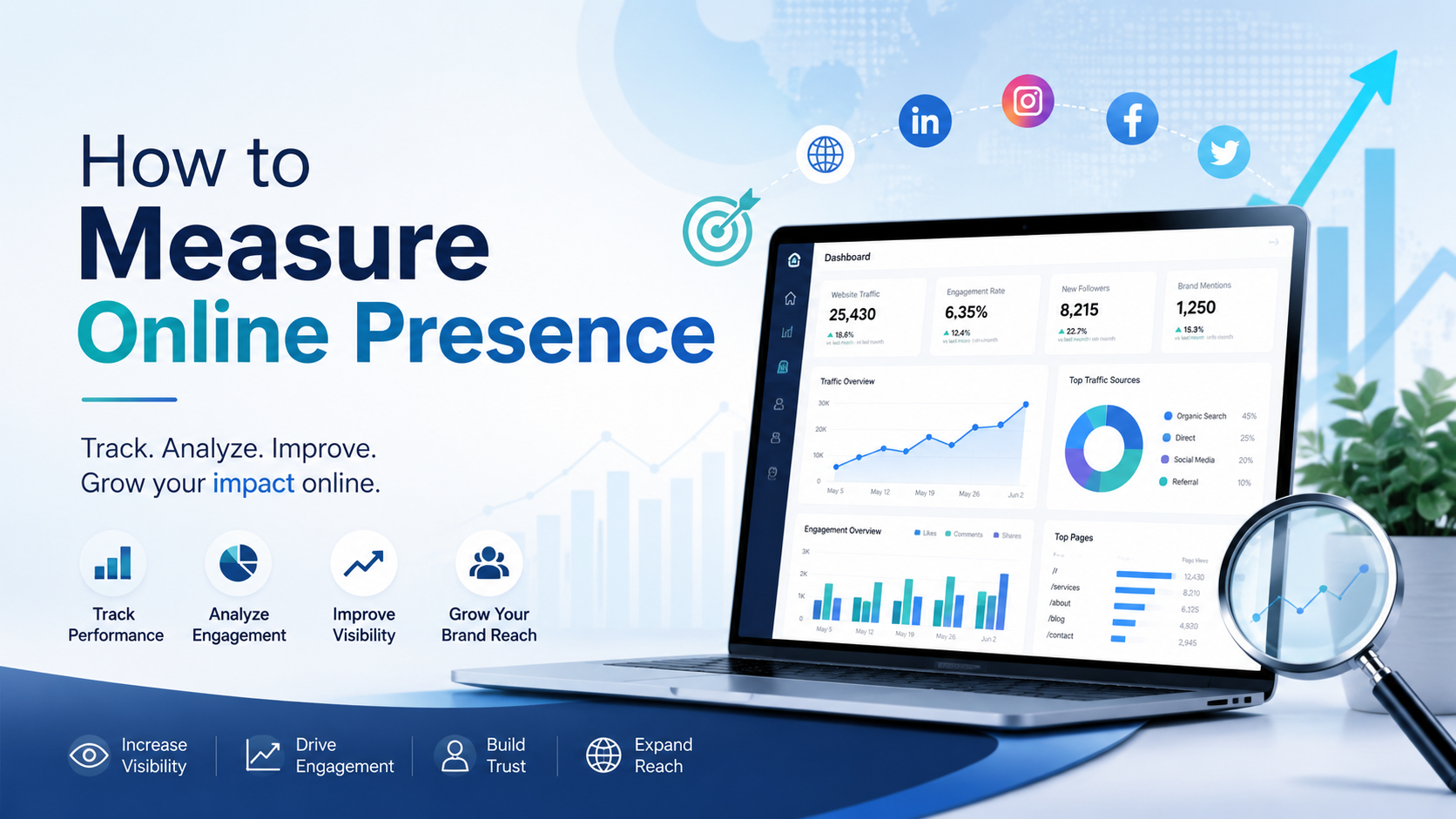
Measuring online presence is not the same as checking whether your website has traffic. Traffic is only one piece of the puzzle. A business can have thousands of visitors and still fail if the visitors are not qualified, the website loads slowly, the offer is unclear, the content does not build trust, or the tracking setup cannot connect marketing activity to sales.
The best way to measure website performance is to measure the entire path from visibility to business outcome. That means checking how people discover your brand, how they behave on your website, how fast the website responds, how well pages convert, how your content performs in search, how social platforms support discovery, how reviews and mentions shape trust, and how all of that affects leads, purchases, bookings or enquiries.
This article explains how to measure online presence using a professional framework built for modern businesses. It also introduces a new angle: the Presence-to-Performance Index, a practical scoring model that helps business owners avoid vanity metrics and focus on the numbers that actually move sales.
Many online guides explain website measurement by listing metrics such as page views, traffic sources, bounce rate, conversion rate, page speed and social engagement. Those are useful, but they are often presented as separate numbers. The problem is that business owners do not need more disconnected reports. They need a clear answer to a simple question: is our online presence getting stronger, and is it helping the business grow?
That is where Blackstone Intelligence brings a stronger approach. Instead of treating analytics as a dashboard decoration, Blackstone Intelligence treats online presence as a business operating system. Search visibility, social performance, website experience, app workflows, lead quality and sales outcomes should be measured together, not separately. For a business that wants evidence from real projects, Blackstone’s case studies library shows how digital strategy is connected to measurable outcomes.
What the top articles say about measuring online presence
The top ranking articles for this topic usually make three strong points. First, website performance needs analytics tools. Second, performance should be connected to digital marketing KPIs. Third, technical speed, Search Console data and regular audits matter. Those ideas are correct. However, the missing angle is business linkage. Most articles explain what to measure, but not how to decide which metrics matter most for your sales model.
| Article Focus | Main Topics | Gap |
|---|---|---|
| Website performance | Speed, GA4, testing | Less sales linkage |
| Marketing KPIs | CRO, CAC, CLV | Broad KPI list |
| Website audits | Monthly checks, GSC, PSI | Tool-led view |
The new angle is this: website performance should not be measured as a technical score alone. It should be measured as a chain. If your search visibility improves but your landing page does not convert, your online presence is incomplete. If your social media reach grows but no one clicks through to the website, your online presence is noisy but weak. If your website converts well but has no visibility, it is a good machine with no fuel.
The best measurement question is not “How many visitors did we get?” It is “How much qualified visibility did we turn into useful action, trust, leads, sales and repeat engagement?”
The Presence-to-Performance Index
The Presence-to-Performance Index, or PPI, is a simple scoring system for measuring online presence without getting lost in endless dashboards. It combines five areas: search visibility, website experience, conversion performance, social and brand momentum, and business outcome. Each area receives a score from 0 to 20. Together, they create a 100-point picture of digital health.
This model is useful because it shows where the business is actually weak. A company might score 18 out of 20 for social presence but only 6 out of 20 for website conversion. Another company might score well for page speed but poorly for search visibility. The PPI helps Blackstone Intelligence decide whether the next move should be SEO, web design, social content, app development, analytics improvement or conversion optimisation.
| PPI Layer | Score Range | Measures |
|---|---|---|
| Search visibility | 0–20 | Rankings, clicks, impressions |
| Website experience | 0–20 | Speed, UX, mobile |
| Conversion performance | 0–20 | Forms, leads, sales |
| Social and brand | 0–20 | Reach, mentions, trust |
| Business outcome | 0–20 | Revenue, pipeline, ROI |
Infographic: the online presence measurement chain
This chain is important because online presence is not one platform. It is the combined effect of every touchpoint a person uses to understand your brand. Someone may first see your business on TikTok, then search your name on Google, then read reviews, then visit your website, then compare competitors, then message your team. If you only measure the website visit, you miss the journey that created it.
Website performance starts with visibility
Website performance begins before the visitor arrives. If the website cannot be found, the website cannot perform. That is why search visibility is the first layer of measurement. You need to understand whether your important pages appear for the right keywords, whether impressions are growing, whether clicks are improving, and whether your pages are attracting qualified visitors.
Important visibility metrics include Google Search Console impressions, clicks, click-through rate, average position, branded searches, non-branded searches, local search visibility, keyword coverage and referral traffic. Search Console data is especially useful because it shows how your site appears in Google Search before a user clicks. If impressions are increasing but clicks are low, the issue may be title tags, meta descriptions, search intent mismatch or weak brand trust.
Blackstone Intelligence uses this visibility data to separate “seen but ignored” pages from “seen and clicked” pages. That distinction matters. A business may already have search exposure, but the search snippet may not be persuasive enough. Another business may have strong content but no keyword targeting. For this reason, a strong measurement system should connect Search Console data with landing page analytics and conversion data.
When a website needs stronger search discovery, Blackstone can improve keyword targeting, technical SEO, content structure and AI search readiness through search visibility and SEO marketing services. This is relevant because visibility measurement is not only about reporting rankings; it is about turning search demand into useful business traffic.
Graph: sample Presence-to-Performance Index
The chart below shows a sample PPI audit for a business with decent visibility but weak conversion and business outcome tracking. This is common. Many companies produce content and receive visitors, but they do not have clean tracking to show whether those visitors turn into real leads or sales.
In this example, the business does not need to produce more random content immediately. It first needs to fix tracking, improve CTAs, strengthen landing page messaging and connect website actions to sales outcomes. Without that, more visibility may only create more unmeasured traffic.
Website experience: speed, usability and clarity
The second layer is website experience. A website should be fast, mobile-friendly, accessible, clear and easy to use. If a visitor lands on a slow page, cannot understand the offer, cannot find the call to action, or struggles on mobile, the website is not performing even if traffic is high.
Technical performance should include Core Web Vitals, page load speed, mobile usability, uptime, image optimisation, JavaScript weight, accessibility and form usability. User experience should include navigation clarity, content readability, button placement, trust signals, pricing clarity, service explanations and contact flow. These are not separate from sales. They influence whether people stay, trust and act.
Blackstone Intelligence measures website experience using both machine data and human review. PageSpeed Insights and performance tools show technical issues. Analytics shows user behaviour. Heatmaps and recordings show friction. Manual review shows whether the message makes sense. This combination helps avoid the mistake of treating a website as “good” just because it looks nice.
When the audit shows that the website is the bottleneck, a conversion-focused rebuild may be needed. Blackstone’s website design and conversion-ready site systems are relevant here because measurement often reveals that business growth is blocked by poor page structure, weak UX or unclear visitor journeys.
Conversion performance: the metric that connects traffic to action
Conversion performance measures whether visitors do what the business wants them to do. That action may be buying a product, submitting a form, booking a call, sending a WhatsApp message, downloading a guide, joining a mailing list, calling a branch or requesting a demo.
The problem is that many websites track only page views. Page views are not enough. A business needs key events, goal completions, lead source data, conversion rate, cost per lead, call tracking, form quality and CRM connection. A high-traffic website with no conversion tracking is like a shop with no cashier record. You know people came in, but you do not know what happened next.
Blackstone Intelligence audits conversion performance by mapping every important visitor action. Then it checks whether those actions are tracked properly. If a WhatsApp button is critical to sales, it should be tracked. If phone calls matter, call tracking should be used. If forms produce leads, the lead should enter a CRM or sheet with source data. The goal is to measure not only conversion volume but lead usefulness.
| Action | Metric | Business Signal |
|---|---|---|
| Form submit | Lead count | Enquiry demand |
| WhatsApp click | CTA click | Intent signal |
| Product purchase | Revenue | Sales result |
| Call click | Call lead | Urgent interest |
| Repeat visit | Return rate | Brand interest |
Social and brand measurement
Online presence is not only search. Social platforms influence awareness, trust and buying decisions. A visitor may discover your brand through a short video, then search for your business later. If your measurement only looks at direct website conversions, you may undervalue social media because social often assists the sale rather than closes it immediately.
The right social metrics include reach, engagement quality, save rate, profile visits, link clicks, comment sentiment, share of voice, branded search lift and conversions from tagged links. Vanity metrics can still be useful, but only when they are interpreted correctly. Followers alone do not prove business growth. A small but engaged audience that clicks, asks questions and buys can be more valuable than a large inactive audience.
Blackstone Intelligence connects social performance to website analytics using tagged links, funnel reporting and campaign dashboards. This matters because social media should not be treated as a posting habit. It should be treated as a source of discovery, demand and trust. For companies that need this system, Blackstone’s social media agency support in Malaysia helps turn content into measurable brand momentum.
Pie chart: what a complete online presence score should include
- Search visibility: 25%
- Website experience: 19%
- Conversion performance: 20%
- Social and brand trust: 18%
- Business outcome tracking: 18%
This distribution is a practical model, not a universal rule. An ecommerce site may place more weight on conversion and revenue. A new brand may place more weight on visibility and trust. A B2B company may place more weight on lead quality, pipeline and sales cycle length. The point is to avoid measuring only one part of the digital journey.
Business outcome: the missing layer in most reports
Business outcome measurement is the layer most dashboards miss. Many reports show traffic, engagement and rankings, but they do not show whether marketing helped the company make money, save time, reduce friction or improve customer quality. That is why Blackstone Intelligence connects online presence measurement to revenue, leads, cost, operations and workflow health.
For service businesses, the key question is whether website visitors become qualified enquiries. For ecommerce, the question is whether visitors buy and return. For local businesses, the question is whether search and social content lead to calls, visits and bookings. For app-based businesses, the question is whether users complete the journey inside the product.
In some situations, the best way to measure online presence is to build a custom dashboard or app workflow that connects website activity, forms, CRM data and operations. Blackstone’s business app development and dashboard workflows are relevant when standard analytics tools are not enough and the business needs a custom system for leads, orders, reports, approvals or customer journeys.
Case studies: why Blackstone Intelligence is credible in this topic
Blackstone Intelligence is not approaching online presence measurement as a theory exercise. The team has case studies across SEO, social commerce, AI automation, web systems and digital campaigns. These projects show that measuring online presence is not only about counting clicks. It is about changing business outcomes through better visibility, faster workflows and clearer customer journeys.
Eyonic Sdn Bhd: measuring local search visibility and lead quality
In the Eyonic Sdn Bhd case study, the challenge was not only poor rankings. The company had strong offline credibility but weak digital visibility. The solution combined a high-performance website, local SEO, service-specific landing pages and social authority content. The reported results included 315% organic traffic growth, Top 3 rankings for core keywords and 180% qualified lead growth.
This case is directly related to measuring online presence because it proves that visibility must be measured with lead quality. More traffic is useful only when it brings people who are ready to enquire. The Eyonic example shows why a proper website performance report should include rankings, landing page behaviour, qualified leads and authority signals.
Sinar Saredah: measuring local SEO, ads and B2B growth together
The Sinar Saredah case study shows how local visibility and paid acquisition can work together. The reported results included 420% local search visibility growth, 3.5x ROAS and +85% growth in B2B contracts. This matters because many businesses separate SEO and ads into different reports, even though both affect the same customer journey.
The lesson is simple: online presence should be measured as a multi-channel system. Local search visibility, ad efficiency, landing page quality, review strength and B2B enquiry quality should be reviewed together. If one channel improves but the business outcome does not, the measurement system should expose the gap.
Sarawak Fruit Enterprise: measuring social commerce beyond likes
The Sarawak Fruit Enterprise case study connects social media performance directly to sales. The case reports RM10,000 revenue in the first month, 450% follower growth and 12,000+ peak live viewers. This is important because social media measurement is often trapped in vanity metrics.
The meaningful part is not only that followers grew. The meaningful part is that a social commerce channel produced revenue. A strong online presence measurement system should capture reach, engagement, conversion, revenue and the operational ability to repeat the campaign.
Pokemon Cards Kuching: measuring automation and customer journey efficiency
The Pokemon Cards Kuching case study shows that online performance is not only marketing. It is also operations. The reported results included 95% admin time reduction, 24/7 automated sales and support, and 300+ active community members.
This case matters because a business can have demand but still lose sales if the customer journey is messy. Automation, inventory clarity and fast replies improve performance. Measuring online presence should therefore include operational metrics such as response time, enquiry handling, stock accuracy and admin hours saved.
Pros and cons of measuring online presence deeply
A deep measurement system gives businesses much more clarity, but it also creates new responsibilities. More data is useful only when the business knows what to do with it. Poorly organised measurement can create noise, confusion and false confidence.
Pros
- Clearer growth decisions.
- Better marketing ROI.
- Faster issue detection.
- Stronger lead quality tracking.
- Better website optimisation.
- More accountable campaigns.
- Improved sales alignment.
Cons
- Too many metrics can confuse teams.
- Tracking setup takes time.
- Bad data creates bad decisions.
- Privacy rules must be respected.
- Attribution is rarely perfect.
- Dashboards need maintenance.
- Tools do not replace strategy.
Upcoming trends in online presence measurement
The next stage of online presence measurement will be less about counting individual channel metrics and more about understanding digital influence. Search, social media, AI answers, reviews, videos, apps, chatbots and offline behaviour will become more connected. Businesses that measure only website sessions will miss the bigger picture.
1. AI visibility and answer engine tracking
Businesses will increasingly measure whether their brand is visible in AI-assisted search experiences, answer engines and summaries. Traditional rankings still matter, but brands also need to understand whether their content is clear, authoritative and structured enough to be referenced by AI-driven discovery systems.
2. First-party data and privacy-safe analytics
Businesses are moving away from relying only on third-party cookies. First-party data, consent-based tracking, server-side tracking, CRM integration and customer data platforms will become more important. This changes measurement from “track everything secretly” to “earn trust and collect useful data responsibly.”
3. Real user experience scoring
Core Web Vitals and real user monitoring will remain important because performance is not only a lab score. A page may test well in one environment but perform poorly for real users on mobile connections. Businesses need to measure real user experience, not only synthetic tests.
4. Multi-touch conversion measurement
A customer may see a TikTok video, search the brand, read a blog, click a retargeting ad, check reviews and then contact the business. Measurement systems will need to show assisted influence, not only last-click conversion. This is especially important for service businesses where trust develops over time.
5. Operational analytics
Online presence will be measured beyond marketing. Businesses will track response time, quote speed, CRM follow-up, order status, support quality, app usage and workflow bottlenecks. This trend is important because a strong website does not guarantee sales if the team behind the website cannot respond quickly.
Step-by-step Blackstone Intelligence implementation strategy
Here is how Blackstone Intelligence can implement a complete measurement system for a business that wants to understand and improve its online presence.
Step 1: Define the business outcome
The process starts with the question: what does success mean? For one company, success may be qualified enquiries. For another, it may be ecommerce sales. For another, it may be app registrations, bookings, store visits or repeat purchases. Blackstone Intelligence defines the main outcome before choosing metrics.
Step 2: Map every digital touchpoint
The team maps the full digital footprint. This includes the website, social profiles, Google Business Profile, app journeys, landing pages, paid campaigns, email lists, WhatsApp links, review platforms, referral sources and CRM stages. The goal is to understand where customers discover, evaluate and contact the business.
Step 3: Build a measurement plan
Each touchpoint receives a measurement role. Search Console tracks visibility. Analytics tracks website behaviour. PageSpeed tools track experience. CRM data tracks lead quality. Social analytics track content momentum. Call or WhatsApp tracking captures direct intent. The measurement plan prevents teams from collecting random metrics.
| Layer | Tool Type | Main Output |
|---|---|---|
| Search | GSC | Query visibility |
| Website | Analytics | User behaviour |
| Speed | PSI | Page experience |
| Leads | CRM | Lead quality |
| Social | Platform data | Content impact |
Step 4: Fix tracking gaps
Before optimisation begins, Blackstone Intelligence checks whether important actions are being tracked. Common gaps include untracked WhatsApp clicks, missing form events, no UTM tagging, duplicated analytics tags, no CRM source field, missing ecommerce events, no call tracking and broken conversion goals. These gaps must be fixed before performance is judged.
Step 5: Score the business with the PPI model
The business is scored across search visibility, website experience, conversion performance, social and brand momentum, and business outcome tracking. The score highlights the biggest bottleneck. This prevents the business from spending budget on the wrong thing. For example, a company with strong traffic but weak leads should focus on conversion and trust, not only more content.
Step 6: Prioritise fixes by impact
Blackstone Intelligence then ranks actions by impact, effort and urgency. Critical fixes may include broken tracking, slow landing pages, poor mobile usability, missing service pages, weak CTAs, poor local SEO, low-quality content or disconnected CRM data. Smaller fixes can wait until major blockers are resolved.
Step 7: Implement channel-specific improvements
After the bottleneck is identified, implementation begins. Search visibility may require keyword mapping and content optimisation. Website experience may require redesign or speed work. Social momentum may require content systems and campaign planning. Operational gaps may require dashboards, automations or app workflows.
Step 8: Create a live performance dashboard
The final system should not be a one-time report. Blackstone Intelligence builds a dashboard that tracks the metrics that matter. This dashboard can show visibility, traffic, engagement, conversions, lead source, lead quality, revenue and trend changes. It should be easy enough for a business owner to understand and detailed enough for a marketing team to act on.
Step 9: Run monthly decision reviews
Every month, the team reviews what changed, what improved, what declined and what action should happen next. This is where measurement becomes strategy. Instead of reporting numbers for the sake of reporting, Blackstone Intelligence uses the numbers to decide where to invest effort.
Line graph: how measurement improves performance over time
Good measurement does not instantly fix a business. It creates clarity. When tracking improves, the team can identify the right problems. When the right problems are fixed, the website starts converting better. When conversion improves, traffic becomes more valuable. Over time, performance compounds.
30-day measurement checklist
A business can start measuring online presence in 30 days if the process is structured. The goal is not to build the perfect dashboard immediately. The goal is to create a reliable baseline and identify the most important performance bottlenecks.
[ ] Define one primary business goal.
[ ] List all website, social and app touchpoints.
[ ] Connect Search Console and analytics.
[ ] Set up key events and conversions.
[ ] Track WhatsApp, phone and form clicks.
[ ] Audit Core Web Vitals and page speed.
[ ] Review top landing pages.
[ ] Review traffic sources and UTMs.
[ ] Check local search and reviews.
[ ] Measure social reach and link clicks.
[ ] Connect leads to CRM or spreadsheet.
[ ] Score the PPI layers.
[ ] Identify the biggest bottleneck.
[ ] Create a 90-day improvement roadmap.
Common mistakes when measuring website performance
1. Measuring traffic without quality
More visitors do not always mean better performance. A website needs qualified traffic. If visitors arrive from irrelevant keywords or weak social posts, they may leave quickly. Always compare traffic with engagement, conversion and lead quality.
2. Measuring only last-click sales
A customer may see multiple touchpoints before buying. If you measure only the final click, you may undervalue the content, social post, review or search result that created trust earlier.
3. Ignoring technical experience
Slow pages, broken forms, poor mobile layout and unclear navigation can hurt performance. Website measurement should always include user experience and technical quality.
4. Reporting without action
A report is useful only if it changes what the business does next. Every metric should lead to a decision, such as fixing a page, improving content, changing a campaign or adjusting budget.
5. Treating social media as separate from the website
Social media often creates awareness and trust before a website visit happens. Use tagged links and campaign tracking to understand how social supports the wider digital journey.
Final answer: what is the best way to measure website performance?
The best way to measure website performance is to measure the website as part of the full online presence system. Start with visibility, then review user experience, then track conversions, then connect leads or sales to business outcomes. Do not stop at traffic. Do not stop at page speed. Do not stop at followers. A serious measurement system must show whether your online presence attracts the right people, gives them a good experience, earns trust, and moves them toward a valuable action.
Blackstone Intelligence is strong in this topic because its work is not limited to dashboards. Its case studies show SEO ranking growth, local visibility improvements, social commerce revenue, workflow automation and lead generation outcomes. That mix matters. Measuring online presence requires more than one discipline. It requires search, web design, social strategy, app workflows, analytics and business thinking working together.
In 2026, the businesses that win will not be the ones with the most metrics. They will be the ones that know which metrics matter. The Presence-to-Performance Index gives business owners a practical way to move beyond vanity numbers and understand the real health of their digital footprint.
External sources cited