Manufacturing is entering a more demanding phase. Cost pressure, labour constraints, supply chain uncertainty, energy management, quality expectations, and faster customer requirements are forcing business owners to rethink how production decisions are made. For Malaysian manufacturers, the question is no longer whether technology belongs on the factory floor. The sharper question is which technologies can improve margin, resilience, speed, and market competitiveness without creating unnecessary complexity.
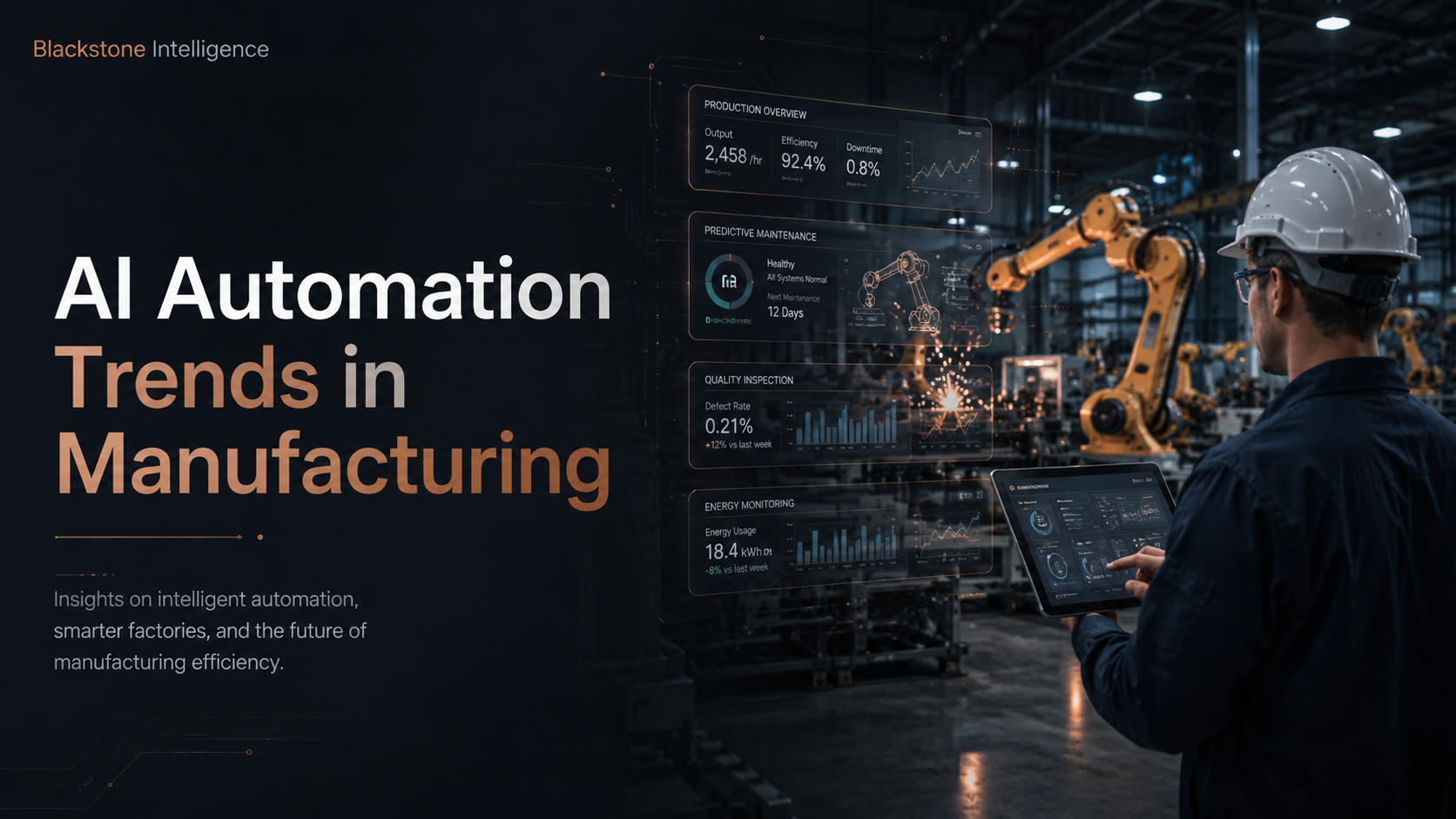
This is why **AI automation trends in manufacturing** matter now. Artificial intelligence is moving beyond isolated tools and dashboards. It is increasingly being used to support planning, maintenance, quality control, production scheduling, procurement decisions, warehouse movement, and customer fulfilment. In practical terms, this means manufacturers can begin shifting from reactive operations to more predictive and adaptive operating models.
However, adoption should not start with technology excitement. It should start with commercial priorities. A factory does not become more competitive simply because it installs sensors, software, robots, or analytics platforms. Value is created when automation is connected to clear business outcomes: reducing downtime, improving delivery reliability, increasing production flexibility, protecting product quality, lowering waste, or enabling faster response to market demand.
From a strategic growth perspective, Blackstone Consultancy would analyse this topic through three connected lenses.
First, we would look at operational readiness. This includes the quality of production data, the maturity of existing systems, process consistency, workforce capability, and whether management teams have the visibility needed to make better decisions. AI is only as useful as the environment it operates in.
Second, we would assess commercial impact. Not every automation opportunity deserves immediate investment. The priority should be areas where improved accuracy, speed, or autonomy can create measurable business advantage. For example, better demand forecasting may strengthen inventory planning, while predictive maintenance may support more reliable output and customer commitments.
Third, we would evaluate market positioning. Manufacturers that modernise intelligently can strengthen their value proposition to buyers, distributors, and regional partners. This matters especially for companies competing on reliability, certification, customisation, export readiness, or speed-to-market rather than price alone.
The opportunity is significant, but the approach must be disciplined. Business owners and marketing teams should view AI-led manufacturing change not only as an internal efficiency project, but as a growth strategy. The companies that benefit most will be those that connect factory intelligence with customer value, commercial planning, and long-term competitive positioning.
What The Market Is Really Responding To
The rising interest in **AI automation trends in manufacturing** is not just a technology story. It reflects a wider market shift: customers, distributors, procurement teams, and business partners are paying closer attention to reliability, speed, traceability, and operational resilience. For Malaysian manufacturers, this changes how the market evaluates both capability and credibility.
Customers Are Buying Confidence, Not Just Output
Manufacturing buyers increasingly want assurance that suppliers can deliver consistently despite labour constraints, cost pressure, and supply chain disruption. They may not ask directly about machine learning models, autonomous systems, or digital twins. Instead, they ask commercial questions:
- Can you meet tighter turnaround times?
- Can you maintain consistent quality across batches?
- Can you provide better production visibility?
- Can you scale without increasing risk?
- Can you respond quickly when demand changes?
AI automation becomes relevant because it supports these outcomes. The market is responding to operational confidence. Businesses that can explain how their production systems reduce downtime, improve planning, or strengthen quality control are likely to appear more dependable than those competing only on price.
Category Signals Are Becoming More Sophisticated
In many manufacturing categories, "advanced technology" is no longer a vague brand claim. Buyers are looking for clearer signals: smarter maintenance practices, better data capture, automated inspection, integrated planning, and faster reporting. These signals influence perception before a sales conversation even begins.
This matters for marketing teams. If a manufacturer is investing in automation but communicates it poorly, the market may not understand the value. A website, LinkedIn presence, sales deck, or trade show message should translate technical upgrades into business benefits: fewer delays, better consistency, improved compliance readiness, and stronger production transparency.
Working with a specialist social media agency can help manufacturers turn complex operational improvements into content that customers, partners, and hiring markets can understand.
Brand Perception Is Moving Toward Capability Proof
Manufacturing brands are being judged less by what they claim and more by what they can demonstrate. A company that talks about smart production should support the message with credible proof points: process explanations, leadership commentary, facility updates, certifications, case-style narratives, or educational content.
This does not mean revealing sensitive operational details. It means showing enough substance for the market to believe the business is modern, disciplined, and future-ready.
Commercial Intent Is Strongest Where Pain Is Clear
Search and content interest around this topic often comes from companies facing practical pressure: rising costs, inconsistent output, manpower shortages, quality issues, or customer demands for better reporting. The commercial opportunity is to meet that intent with clear, grounded content that helps decision-makers understand where automation creates business value-not just technical novelty.
The Strategic Pattern Beneath The Surface
The most important shift is not only technical. It is commercial. Behind the visible discussion about robotics, digital twins, predictive systems, and autonomous operations, a clearer pattern is emerging: manufacturers are being judged less by what they produce alone, and more by how intelligently, reliably, and transparently they operate.
For Malaysian manufacturers, this affects how the business should position itself, how offers are packaged, what content should be published, and how sales conversations should be guided.
From Capability Claims To Operational Confidence
Many manufacturing brands still compete on broad claims such as quality, speed, capacity, or cost efficiency. These remain important, but they are no longer enough. Buyers increasingly want confidence that a supplier can handle volatility: shifting demand, tighter deadlines, labour constraints, compliance pressure, and margin sensitivity.
This means positioning must move from "we have the machines" to "we understand the operating risk and can reduce it". Companies that communicate planning discipline, process visibility, traceability, automation readiness, and response speed will appear more prepared than those that only describe facilities and product categories.
Offer Design Must Match Buyer Anxiety
AI automation trends in manufacturing are also changing how buyers evaluate suppliers and solution providers. The demand is not always for a full transformation project on day one. Many decision-makers want a lower-risk entry point: assessment, pilot, integration roadmap, process audit, dashboarding, or a focused improvement around downtime, quality checks, scheduling, inventory, or maintenance.
This creates an opportunity to design offers that match the buyer's stage of readiness. A practical entry offer can convert better than a broad "smart factory solution" because it feels easier to approve, easier to budget, and easier to explain internally.
Search Demand Reflects Business Questions
Search behaviour often reveals what the market is trying to understand before speaking to a vendor. Some users are looking for definitions. Others compare technologies, estimate costs, assess implementation risks, or search for examples relevant to their sector.
A strong content strategy should therefore cover the full decision journey: awareness content for senior leaders, technical explainers for operations teams, comparison pages for evaluators, and conversion pages for buyers ready to discuss scope. The goal is not to publish more content, but to answer the questions that delay action.
Conversion Behaviour Rewards Clarity
When visitors reach a page, they need to quickly understand whether the business can help them make a better decision. Clear use cases, realistic next steps, sector relevance, and practical language usually matter more than futuristic messaging.
The strategic pattern is simple: connect market signals to operational pain, package the response into manageable offers, and make the buying path easier to trust.
Audience, Message, And Channel Fit
For a Malaysian manufacturer, the buyer for AI-led automation is rarely one person. A plant manager may feel the daily pressure of downtime, quality drift, and labour constraints. A finance lead will test the payback logic. A managing director may focus on competitiveness, export readiness, and long-term resilience. IT and operations teams will worry about integration, cyber risk, and whether existing machines can support new systems.
This means the message cannot rely on a single "future of manufacturing" narrative. It must change by audience, decision stage, and level of technical confidence.
Segment The Audience By Business Problem
The most responsive audiences are usually problem-aware. They may not search directly for AI automation trends in manufacturing, but they are already looking for ways to reduce defects, improve throughput, manage energy use, or overcome skilled labour shortages. For this group, practical language works better than abstract innovation claims.
Useful message angles include:
- reducing unplanned stoppages through predictive maintenance;
- improving inspection consistency with machine vision;
- using production data to spot bottlenecks earlier;
- supporting supervisors with better real-time visibility;
- improving scheduling when demand or material supply changes.
For owners and senior leaders, the message should connect automation to commercial control: lower operational risk, stronger margins, and better decision-making. For technical teams, it should explain how systems connect with ERP, MES, PLCs, sensors, and legacy equipment.
Match The Message To The Buying Stage
At the awareness stage, content should educate without overwhelming. Short explainers, industry notes, and practical trend summaries help decision-makers understand what is changing and why it matters.
At the consideration stage, buyers need sharper comparisons. They want to know whether to start with predictive maintenance, quality inspection, digital twins, autonomous material handling, or production planning tools. Content should help them prioritise based on factory maturity, available data, budget, and operational pain points.
At the decision stage, confidence comes from evidence. This may include implementation roadmaps, risk checklists, integration considerations, vendor evaluation criteria, and workshops with both management and technical teams.
Choose Channels That Support Trust
LinkedIn is useful for reaching directors, general managers, and B2B decision-makers. Search content captures active research demand from teams comparing options. Email is effective for nurturing existing customers or prospects who need internal alignment over several months. Webinars and closed-door briefings work well when the topic is complex and multiple stakeholders need to ask questions.
The strongest channel mix is not the loudest one. It is the one that gives each audience the right evidence at the right point in the decision.
What Malaysian Businesses Can Apply
AI in manufacturing should not stay inside the production line. For Malaysian manufacturers, the same intelligence that improves planning, quality control, and automation can also strengthen how the business communicates, sells, and builds trust in the market. The practical opportunity is to connect operational insight with sharper marketing decisions.
Turn factory intelligence into market messaging
If your business is investing in automation, robotics, predictive maintenance, or digital twins, those improvements can become credible proof points for customers. Buyers want reliability, consistency, traceability, and speed. Marketing teams should translate internal process upgrades into clear customer-facing messages, such as shorter lead times, stronger quality assurance, better order visibility, or improved production flexibility.
This is where a social media agency or digital marketing partner can help convert technical progress into content that customers understand. Instead of posting generic factory photos, manufacturers can build content around process transparency, engineering capability, compliance readiness, sustainability efforts, and behind-the-scenes operational discipline.
Use AI signals to plan better campaigns
The rise of AI automation trends in manufacturing also highlights a wider lesson: better decisions come from better data. Marketing teams can apply this by reviewing customer enquiries, website behaviour, social media engagement, CRM notes, and sales feedback to identify what the market actually cares about.
For example, if enquiries frequently mention customisation, urgent delivery, halal compliance, export readiness, or OEM capability, these themes should shape campaign content. Paid ads, LinkedIn posts, landing pages, and email campaigns can be structured around real buyer concerns rather than assumptions.
Align sales, operations, and marketing
Many Malaysian manufacturing businesses still treat marketing as separate from production and sales. That creates weak messaging. A more practical approach is to hold regular alignment sessions between operations, sales, and marketing teams.
Operations can share what capabilities are improving. Sales can explain what prospects are asking. Marketing can convert both into campaigns that support commercial goals. This creates a stronger content pipeline for social media, search, brochures, trade shows, and sales presentations.
Start with manageable use cases
Businesses do not need a complex AI ecosystem to begin. Start with practical steps: improve website product pages, create case-based content, build LinkedIn thought leadership for senior leaders, segment audiences by industry, and use marketing automation to follow up with enquiries more consistently.
For Malaysian manufacturers, the key is not to market AI for its own sake. The key is to show how smarter operations create real business value for customers. That is what turns manufacturing innovation into commercial advantage.
Measurement That Keeps The Strategy Honest
A manufacturing AI strategy can sound impressive in a boardroom but still fail to create commercial value. Measurement is what separates useful transformation from technology theatre. For Malaysian manufacturers, the right scorecard should connect market demand, buyer confidence, sales quality, and operational readiness.
Track Search Demand Before Expanding The Message
Search behaviour is an early signal of what the market is ready to understand. Marketing teams should monitor how prospects search around automation, predictive maintenance, quality inspection, robotics, energy optimisation, and factory visibility. The goal is not only to rank for broad phrases such as AI automation trends in manufacturing, but to identify specific commercial intent.
Useful search indicators include:
- Growth in impressions for problem-based queries
- Click-through rates on technical and commercial topics
- Pages that attract procurement, engineering, or senior management audiences
- Search terms that suggest readiness, such as "vendor", "cost", "implementation", or "Malaysia"
This helps the business avoid overpromoting technology that buyers are not yet evaluating seriously.
Measure Engagement Quality, Not Just Traffic
High traffic is not always a sign of strong demand. A technical audience may read slowly, compare multiple pages, download documents, or return later with colleagues. Engagement quality should therefore be assessed through depth, not volume alone.
Look at whether visitors explore related content, spend time on implementation pages, view case-oriented material, or engage with comparison topics. For complex manufacturing solutions, a smaller group of well-qualified visitors is often more valuable than broad attention from non-buyers.
Connect Leads To Commercial Fit
Lead quality should be reviewed with sales and operations, not judged only by form submissions. A strong lead may come from a plant manager, operations director, quality lead, or business owner who has a clear operational issue and a realistic timeline.
Practical lead quality measures include:
- Job role and decision influence
- Industry and facility type
- Stated operational problem
- Budget maturity or project stage
- Readiness for discovery, audit, or pilot discussion
Marketing reports should highlight which topics produce serious conversations, not just enquiries.
Use Operational Signals To Validate The Promise
AI and automation content must reflect what the company can actually deliver. Review whether internal teams can support the claims being promoted. Signals may include response speed, technical assessment capacity, partner readiness, after-sales support, and implementation documentation.
Build A Repeatable Review Loop
Set a monthly or quarterly review involving marketing, sales, technical, and leadership teams. Compare search trends, engagement behaviour, lead quality, and operational feedback. Keep what generates qualified demand, refine what creates confusion, and retire messages that do not match buyer reality. This keeps the strategy commercially grounded.
Risks, Trade-Offs, And Better Questions
AI-driven manufacturing is not a race to copy the most visible technology. A factory can install sensors, deploy dashboards, pilot autonomous robots, or announce a digital twin and still fail to improve margins, delivery reliability, or customer confidence. The commercial issue is not whether the technology is impressive. It is whether it solves a constraint that matters.
For Malaysian manufacturers, especially SMEs and mid-sized exporters, the danger is over-investing in fashionable tools before the operational basics are ready. Poor master data, inconsistent work instructions, weak maintenance discipline, and fragmented systems can turn an AI project into another layer of complexity.
Mistakes To Avoid Before Scaling
The first mistake is treating AI as a replacement for process clarity. If production planning, quality checks, or inventory controls are already unclear, automation may simply accelerate bad decisions. Teams should document the decision flow first: who acts, what data they use, what exception they handle, and what outcome is expected.
The second mistake is buying platforms before defining the business case. A vendor demo may show predictive maintenance, visual inspection, or autonomous scheduling, but the internal question should be sharper: which downtime, defect, delay, or cost line will this reduce?
The third mistake is ignoring change management. Operators, supervisors, maintenance teams, and planners need to trust the system. If the recommendation is not explainable, or if staff are penalised for questioning it, adoption will remain shallow.
Better Questions For Commercial Decisions
Before copying visible AI automation trends in manufacturing, leadership teams should ask:
- What operational bottleneck are we trying to remove?
- Is the data complete enough to support automated decisions?
- Can the system integrate with existing ERP, MES, maintenance, and quality tools?
- What happens when the AI recommendation is wrong?
- Who owns the model, the workflow, and the final decision?
- How will we measure payback beyond a pilot demonstration?
These questions keep the discussion grounded in risk, cost, and accountability.
Staying Grounded While Moving Forward
The best approach is usually staged. Start with a narrow use case where the cost of failure is manageable and the value is visible. Build internal capability, test assumptions, and create governance around data access, cybersecurity, vendor dependency, and operational accountability.
AI can improve manufacturing performance, but only when it is tied to real business priorities. The companies that benefit most will not be those that automate everything first. They will be the ones that know what not to automate yet.
A Practical Roadmap For Turning The Insight Into Action
For Malaysian manufacturers, the value of studying AI automation trends in manufacturing is not in predicting every technology shift perfectly. It is in making better decisions about where to modernise, what to communicate, and how to build confidence with customers, partners, and internal teams.
1. Start With A Business-First Review
Before discussing platforms, robots, sensors, or analytics dashboards, leadership teams should identify the operational pressures that matter most over the next planning cycle. These may include labour availability, production consistency, machine downtime, energy usage, delivery reliability, quality control, or customer expectations for faster response.
Marketing teams should join this conversation early. The way a company improves its production capability will eventually shape its market positioning, sales messages, recruitment content, and customer education.
2. Map The Current Capability Gap
Create a simple view of where the business stands today. Which processes are still manual? Which systems do not communicate with each other? Where is data collected but not used? Where do customers experience delays or uncertainty?
This does not need to become a complex transformation report at the first stage. A practical gap map helps the business separate urgent priorities from attractive but non-essential technology ideas.
3. Choose One Or Two Pilot Areas
A focused pilot is more useful than a broad announcement with limited execution. Suitable starting points may include predictive maintenance on critical machines, production visibility dashboards, automated quality checks, warehouse movement tracking, or customer-facing order status updates.
The pilot should have a clear owner, a practical timeline, and a defined business question. For example: can this reduce manual follow-up, improve planning accuracy, or make service communication more reliable?
4. Turn Operational Progress Into Market Clarity
When improvements are made, marketing should translate them into credible communication. Avoid vague claims such as "fully automated" or "Industry 4.0 ready" unless they can be substantiated. Instead, explain what has improved in terms customers understand: better traceability, more consistent output, faster response, stronger process control, or improved production visibility.
This can support website content, sales decks, trade show messaging, recruitment campaigns, and customer reassurance materials.
5. Build Measurement Into The Plan
Each initiative should connect to practical metrics. Operational teams may track downtime, defect patterns, throughput, or planning accuracy. Marketing teams may track enquiry quality, sales enablement usage, customer objections, and content engagement around modernisation topics.
The goal is not to chase technology for its own sake. It is to create a repeatable decision system: observe the market, assess the business impact, act in a controlled way, and communicate progress with discipline.