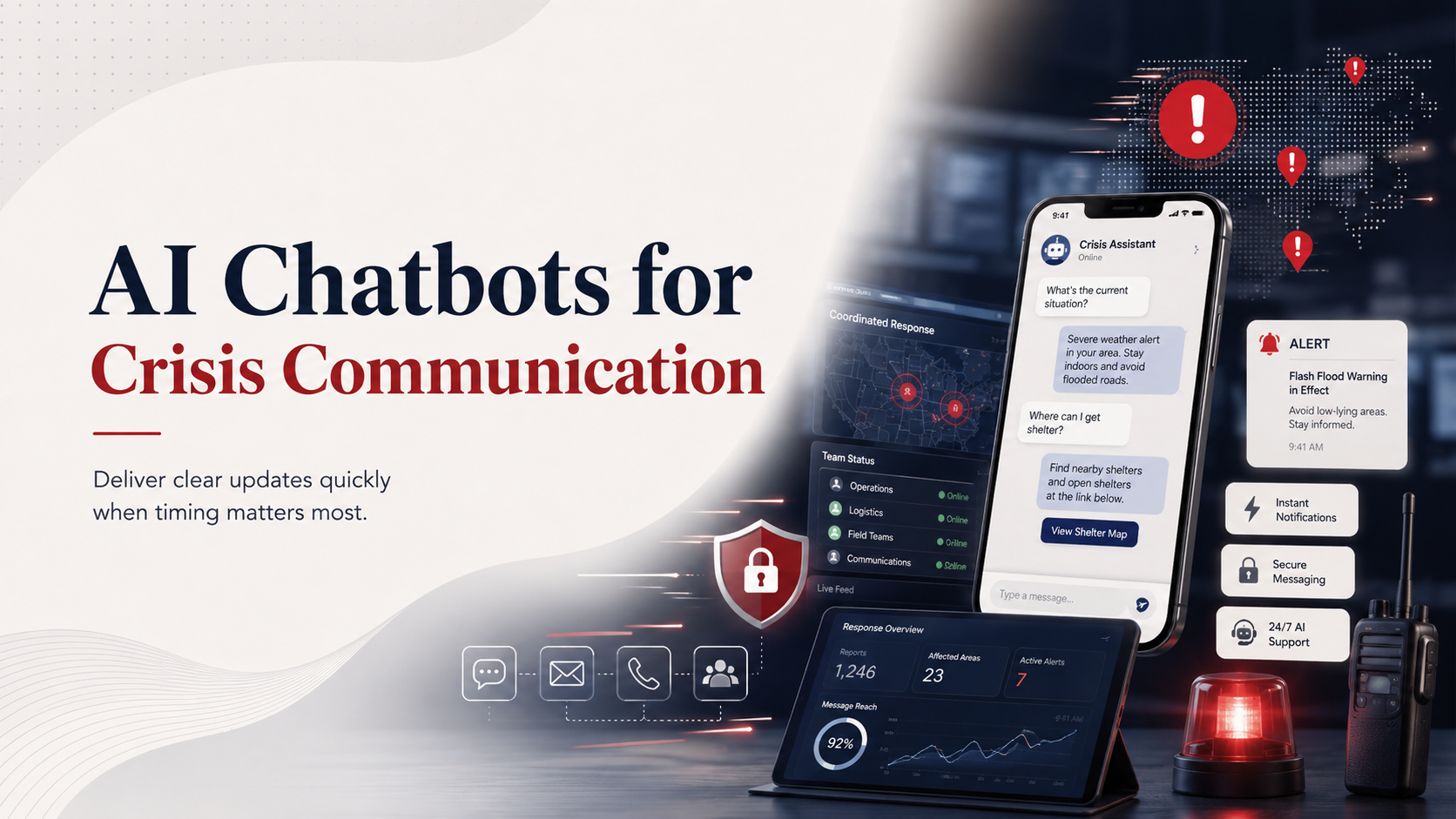
A crisis rarely damages a business through the event alone. The larger risk often comes from slow updates, inconsistent messages, unanswered stakeholder concerns, and a loss of confidence across customers, employees, partners, regulators, investors, and the public. In Malaysia's fast-moving digital environment, where WhatsApp groups, social platforms, online news, and internal channels can amplify uncertainty within minutes, businesses need a more disciplined approach to crisis communication.
This is where **AI Chatbots for Crisis Communication** are becoming commercially relevant. They are not a replacement for leadership, legal judgement, PR strategy, or human empathy. Used properly, they can become part of a wider communication system that helps organisations respond faster, keep messaging aligned, and reduce pressure on frontline teams during high-volume situations.
For Malaysian business owners and marketing teams, the practical question is not whether a chatbot sounds advanced. The question is whether it improves stakeholder trust when the organisation is under pressure. A poorly configured chatbot can create confusion, provide outdated information, or appear insensitive. A well-planned chatbot, however, can help route urgent enquiries, deliver approved updates, capture recurring concerns, support multiple languages where appropriate, and ensure that critical messages remain consistent across channels.
From a strategic growth perspective, Blackstone Consultancy would assess this topic through three lenses.
First, **risk readiness**. Many companies only think about communication tools after a disruption has already occurred. A stronger approach is to map likely crisis scenarios in advance, define stakeholder groups, prepare escalation rules, and decide which responses must remain human-led.
Second, **brand trust**. Crisis communication is not simply about speed. It is about clarity, credibility, tone, and accountability. Chatbots must be governed by approved message frameworks, verified information sources, and clear handover points when a stakeholder needs a person rather than an automated reply.
Third, **commercial resilience**. In a crisis, communication failures can affect sales pipelines, customer retention, employee morale, supplier confidence, and future investor perception. A chatbot strategy should therefore connect to business continuity, reputation management, and customer experience-not sit as an isolated technology experiment.
The opportunity in 2026 is not to automate every response. It is to build a smarter communication layer that supports leadership decisions, protects stakeholder relationships, and gives teams a structured way to respond when pressure is highest. For businesses that depend on trust, preparation is no longer optional.
What The Market Is Really Responding To
During disruption, internal crisis update chatbots can keep staff aligned before public confusion spreads.
When businesses discuss **AI Chatbots for Crisis Communication**, the conversation is rarely about technology alone. The real market interest comes from a more urgent commercial concern: how quickly a brand can protect trust when customers, staff, regulators, media, and online communities are all asking questions at once.
In Malaysia, where consumer conversations move quickly across WhatsApp, Facebook, TikTok, Instagram, X, email, and news portals, silence is often interpreted as avoidance. Slow replies can create the impression that a company is unprepared, insensitive, or hiding information. This is why crisis communication is becoming less of a "PR-only" function and more of a business continuity priority.
Customer Behaviour Has Changed
Customers now expect immediate acknowledgement, even when a full answer is not yet available. They may understand that investigations take time, but they do not respond well to vague statements, inconsistent replies, or repeated "please wait" messages.
During a product issue, service outage, data incident, workplace controversy, or public complaint, people look for three things:
- Confirmation that the business is aware of the issue
- Clear next steps or expected timelines
- A consistent message across all official channels
If customers receive different answers from different touchpoints, confidence drops. This is where structured automation can support-not replace-human crisis teams by ensuring baseline information stays consistent while complex cases are escalated.
Category Signals: From Reactive PR To Prepared Systems
The growing interest in crisis chatbots signals a wider shift in the market. Businesses are no longer satisfied with crisis plans that sit in a PDF folder. They want operational systems that can be activated quickly, updated centrally, and monitored in real time.
Marketing teams are also recognising that crisis response is closely tied to brand performance. A poorly handled incident can affect lead generation, customer retention, recruitment, investor confidence, and partner relationships. For companies working with a social media agency, crisis readiness is increasingly part of the broader conversation around reputation management and always-on digital monitoring.
Brand Perception And Commercial Intent
The commercial intent behind this topic is clear: businesses are looking for ways to reduce reputational damage, control misinformation, and maintain stakeholder confidence during high-pressure moments.
For Malaysian business owners, the key question is not whether automation sounds impressive. It is whether it helps the company respond faster, more accurately, and with the right tone. A chatbot that gives generic answers can make a crisis worse. A well-planned system, connected to approved messaging and escalation rules, can help preserve credibility when public attention is at its highest.
The Strategic Pattern Beneath The Surface
Preparedness improves when teams use crisis journey analysis checkpoints to map where stakeholders look for proof and reassurance.
Crisis communication is often treated as a response problem: something goes wrong, the team prepares a statement, and channels are updated. The deeper commercial pattern is broader. Companies are being judged not only on what they say during disruption, but on whether their communication system appears prepared, coordinated, and trustworthy before pressure peaks.
For Malaysian businesses, this matters because stakeholders are rarely one group. Customers may want service continuity updates, employees need operational clarity, regulators expect accuracy, partners need risk visibility, and the public may be reacting to incomplete information online. A single generic message is usually too slow and too blunt.
Positioning: Preparedness Becomes A Trust Signal
The market signal behind **AI Chatbots for Crisis Communication** is not simply "automation." It is the expectation that serious organisations should be able to answer urgent questions quickly, consistently, and across channels. This shifts positioning from reactive public relations to operational readiness.
A company that can explain its crisis workflow clearly has an advantage. It can show that escalation rules, approved messaging, stakeholder segmentation, and evidence handling are not improvised. This matters in sectors where trust is part of the buying decision, such as healthcare, education, financial services, logistics, property, and professional services.
Offer Design: From Tool Purchase To Response System
The offer is not just a chatbot. The useful business package includes scenario planning, approved response libraries, channel mapping, human escalation, data governance, and post-crisis review. This is where many implementations succeed or fail.
A chatbot that only answers frequently asked questions may help during normal operations. In a crisis, the design must account for uncertainty, changing facts, emotional users, legal sensitivity, and reputation risk. The better offer is a managed communication capability, not a standalone widget.
Content, Search Demand, And Conversion Behaviour
Search behaviour around crisis communication usually increases when leaders recognise exposure. They may not yet know the right solution, but they are looking for control: templates, playbooks, response systems, stakeholder messaging, and reputation protection.
This means content should not only describe features. It should answer commercial questions: Who approves messages? Which channels are covered? How are sensitive cases escalated? What happens when information changes? How does the business measure response quality?
Conversion also tends to be trust-led. Prospects are unlikely to buy based on novelty alone. They need to see judgement, structure, and risk awareness. The strongest page strategy connects external pressure to internal decision-making: what the market expects, how stakeholders behave, what the brand must protect, and what operating model is required.
Audience, Message, And Channel Fit
Some incidents require mental health escalation chatbot safeguards, especially when distress or safety concerns appear in the conversation.
In a crisis, "the audience" is not one group. Malaysian businesses often need to speak to customers, employees, suppliers, regulators, media contacts, investors, and community stakeholders at the same time. Each group has different concerns, different tolerance for uncertainty, and different preferred channels. Effective use of **AI Chatbots for Crisis Communication** starts with segmenting these audiences before pressure rises.
Segment By Risk, Relationship, And Urgency
A practical crisis communication model should separate audiences by three questions:
- **What risk do they face?** Customers may worry about safety, refunds, service disruption, or data privacy. Employees may need shift instructions, HR guidance, or talking points.
- **What relationship do they have with the company?** A long-term client needs reassurance and direct access. A first-time website visitor may need quick proof that the issue is being handled.
- **How urgent is their decision?** Some stakeholders need immediate action, while others are still deciding whether to trust the organisation's response.
This segmentation helps avoid generic messaging. A public-facing chatbot can answer basic updates, but a key account customer may need escalation to a named relationship manager. Internal teams may need a different chatbot flow altogether, focused on operational instructions rather than public reassurance.
Match The Message To The Decision Stage
Problem-aware audiences want clarity first. They are asking, "What happened, and does it affect me?" The message should be direct, plain, and updated regularly.
Comparison-stage buyers are evaluating competence. They look for consistency across the website, chatbot, social media, email, and spokesperson comments. For them, the message must show control: what is known, what is being checked, what action is being taken, and when the next update will come.
Existing customers need reassurance without overpromising. Useful chatbot responses include order impact, support options, documentation links, refund processes, service timelines, and escalation routes.
Internal stakeholders need alignment. Employees should not learn critical updates from public channels first. A separate internal chatbot or controlled knowledge hub can reduce confusion and prevent inconsistent answers from spreading.
Choose Channels Based On Trust And Speed
Not every crisis update belongs on every channel. A chatbot is useful for high-volume questions, triage, and routing. Email is better for formal notices. WhatsApp or SMS may suit urgent operational alerts, where consent and data handling are properly managed. LinkedIn can support corporate updates, while a newsroom or website page should act as the central source of truth.
The key is channel discipline. Each platform should have a role, a message owner, and a clear escalation path. During a crisis, attention is earned by being relevant, timely, and consistent.
What Malaysian Businesses Can Apply
Travel and mobility brands should also prepare travel emergency assistance flows for disruption scenarios that affect real-world movement.
For Malaysian companies, crisis communication is no longer only a PR function activated after something goes wrong. Customer complaints, service disruptions, product issues, staff misconduct, data incidents, and public backlash can move quickly across Facebook, TikTok, Instagram, WhatsApp, X, LinkedIn, Google Reviews, and news portals. The practical value of AI Chatbots for Crisis Communication is in helping businesses respond faster, more consistently, and with better control over message quality.
Build a Crisis Response Playbook Before You Need It
Marketing teams should prepare chatbot-ready response flows for likely scenarios: delivery delays, payment issues, store closures, product recalls, service outages, negative viral posts, or misinformation. Each flow should define:
- What the chatbot can answer immediately
- When to escalate to a human team member
- Which messages require legal, management, or compliance review
- Which channels should carry the official update
- What tone is appropriate for customers, media, employees, and partners
This prevents teams from improvising under pressure and reduces the risk of inconsistent replies across platforms.
Connect Chatbots With Social Media Monitoring
A chatbot should not sit separately from social media activity. Malaysian businesses should connect crisis response planning with social listening, community management, and paid media monitoring. If negative sentiment is rising around a specific issue, the chatbot script, FAQ page, pinned post, and customer service replies should be updated together.
This is where a social media agency or digital marketing partner can support the business: monitoring the conversation, identifying recurring concerns, adjusting response content, and helping management decide when a public statement is needed.
Localise Responses for Malaysian Audiences
Crisis messaging in Malaysia often needs more than one language and more than one tone. A response that works for a corporate LinkedIn audience may not work in Bahasa Malaysia on Facebook or in a WhatsApp customer service thread. Businesses should prepare approved messaging in English and Bahasa Malaysia at minimum, and consider Mandarin or Tamil where relevant to their customer base.
Local context matters. The chatbot should not sound defensive, robotic, or dismissive. It should acknowledge concern, provide clear next steps, and direct users to verified updates.
Keep Humans in Control
AI should support crisis communication, not replace leadership judgement. Sensitive matters involving safety, employment, legal exposure, regulators, or public trust should always escalate to trained staff. The strongest approach is a hybrid model: automation for speed and consistency, human oversight for empathy, accountability, and strategic decisions.
Measurement That Keeps The Strategy Honest
Once the incident settles, trust recovery chatbot journeys can show whether reassurance efforts are helping customers return.
A crisis communication chatbot should not be judged by whether it "works" in a demo. It should be judged by whether it reduces confusion, protects trust, and helps the business make better decisions under pressure. For Malaysian companies operating across multiple languages, channels, and stakeholder groups, measurement must combine marketing data, operational data, and human review.
Search Signals: What People Are Trying To Confirm
Search data is often the first sign that stakeholders are uncertain. Track branded searches, issue-related queries, "is it true" searches, location-specific questions, and comparisons with competitors or regulators. If people are searching for the same reassurance repeatedly, your public messaging may not be clear enough.
For **AI Chatbots for Crisis Communication**, search measurement should also include the questions users ask before they enter the chatbot. This helps teams identify gaps between what the company has published and what the public still needs to know.
Engagement Quality: Beyond Clicks And Sessions
High usage is not always good news. During a crisis, many sessions can indicate panic, unclear communication, or repeated failure to get an answer. Measure whether users complete key tasks: finding official updates, confirming service status, submitting a concern, locating a hotline, or understanding next steps.
Useful quality indicators include repeat questions, escalation rates, abandonment points, unresolved intents, language switching, and the number of times users ask for a human. These signals show whether the chatbot is supporting confidence or simply absorbing traffic.
Lead And Stakeholder Quality
Not every enquiry during a crisis is a sales lead. Some are media requests, supplier concerns, customer complaints, employee questions, regulator-related issues, or community feedback. Your measurement framework should classify these clearly.
For commercial teams, track whether enquiries are legitimate, urgent, duplicated, misrouted, or reputationally sensitive. A smaller number of well-qualified escalations is often more valuable than a large volume of vague contacts.
Operational Signals And Review Loops
Operational data keeps the strategy grounded. Monitor response accuracy, approval delays, outdated answers, handover speed, sentiment shifts, and channel consistency across website, WhatsApp, email, social media, and call centre scripts.
Set a fixed review rhythm during active incidents: hourly for high-risk situations, daily for moderate issues, and post-incident for learning. Each review should answer three questions: what changed, what stakeholders misunderstood, and what message needs correction. This discipline prevents the chatbot from becoming a static FAQ when the situation is still moving.
Risks, Trade-Offs, And Better Questions
Crisis technology can create speed, but speed without judgement can create a larger problem. For Malaysian businesses, the risk is not only saying the wrong thing. It is appearing careless, evasive, or commercially opportunistic when customers, staff, regulators, media, and partners are looking for clarity.
AI Chatbots for Crisis Communication should therefore be treated as part of a governed response system, not a shortcut around leadership, legal review, or stakeholder management.
Mistakes To Avoid
The first mistake is copying a visible tactic because another brand used it well. A public chatbot, WhatsApp update flow, or automated FAQ may look simple from the outside, but the hidden work is usually governance: approved messaging, escalation rules, data handling, and internal alignment.
The second mistake is over-automation. Not every crisis question should be answered by a bot. Issues involving injury, legal liability, employee welfare, financial exposure, or regulatory scrutiny often need human review. A good system knows when to stop answering and route the matter to the right team.
The third mistake is treating all stakeholders the same. Customers may need refunds, timelines, and reassurance. Employees may need instructions and internal safety updates. Investors may need operational impact. Media may need verified statements. A single generic message can feel efficient internally but weak externally.
The fourth mistake is poor source control. If the chatbot pulls from outdated FAQs, unapproved statements, or conflicting internal documents, it may spread confusion faster than a human team ever could.
Better Questions Before Copying A Tactic
Before launching a crisis chatbot or automated response flow, teams should ask:
- What exact problem are we solving: volume, speed, consistency, triage, or documentation?
- Which questions can be safely answered automatically, and which require escalation?
- Who approves the wording during a fast-moving incident?
- How will we update messages if facts change within the hour?
- What languages and channels matter most for our Malaysian audience?
- How will we record interactions without mishandling sensitive data?
- What is the fallback if the chatbot gives an unsuitable answer?
These questions are less exciting than a new tool demo, but they determine whether the system protects trust or damages it.
Staying Commercially Grounded
Crisis communication should support business continuity. That means reducing call centre pressure, protecting customer confidence, giving teams a single source of truth, and helping leadership see what people are asking in real time.
The goal is not to automate empathy. The goal is to make reliable information easier to access while preserving human judgement where it matters most. A commercially sound approach starts small, tests realistic crisis scenarios, assigns owners, reviews risks, and measures whether the system improves response quality-not just response speed.
A Practical Roadmap For Turning The Insight Into Action
For stakeholder education, crisis briefing webinar bots can help teams collect questions before and after formal updates.
For Malaysian business owners and marketing teams, the next step is not to "install a chatbot" and hope it performs under pressure. The practical priority is to build a crisis communication system that is clear, governed, tested, and connected to real decision-making. AI Chatbots for Crisis Communication should sit inside that system, not replace it.
1. Define The Crisis Scenarios That Matter
Start with the situations most likely to affect trust in your organisation. These may include service disruption, data privacy concerns, product quality issues, public complaints, regulatory enquiries, supply chain delays, employee incidents, or misinformation spreading online.
For each scenario, document:
- Who needs to be informed first
- What questions stakeholders will ask
- Which facts can be shared immediately
- Which matters require legal, compliance, or leadership approval
- Which channels will carry the official response
This gives your chatbot, content team, and leadership team the same operating map.
2. Build A Message Governance Framework
A crisis chatbot is only as reliable as the information and rules behind it. Create approved response tiers before a crisis occurs:
- **Tier 1:** General holding statements and acknowledgement messages
- **Tier 2:** Operational updates such as closures, delays, or service changes
- **Tier 3:** Sensitive responses requiring escalation to legal, HR, compliance, or senior management
- **Tier 4:** No-response or human-only categories, such as investigations or confidential matters
This prevents the business from over-answering, speculating, or creating inconsistent public statements across departments.
3. Connect The Chatbot To Human Escalation
A good crisis communication setup must know when automation should stop. Define escalation triggers such as media enquiries, legal threats, safety concerns, VIP customers, regulator mentions, hostile sentiment, or repeated unanswered questions.
Marketing teams should work with customer service, operations, legal, and leadership to agree on:
- Escalation owners
- Response time expectations
- Approval workflows
- After-hours coverage
- Record-keeping requirements
This is especially important for businesses serving multilingual, multi-channel Malaysian audiences.
4. Test Before The Business Needs It
Run tabletop exercises every planning cycle. Simulate a crisis, review chatbot responses, check escalation paths, and identify gaps in tone, accuracy, or timing. Include Bahasa Malaysia and English variations where relevant, and test responses across website chat, WhatsApp, social platforms, and email support.
5. Measure What Improves Decisions
Track practical indicators such as unresolved question themes, escalation volume, response consistency, stakeholder concerns, and content gaps. Use these findings to improve FAQs, holding statements, landing pages, internal playbooks, and leadership briefings.
The objective is not simply faster replies. The objective is a calmer, more coordinated organisation that can communicate clearly when trust is under pressure.